
Oregon TANF Program
Updated: June 30, 2011
Temporary Assistance for Needy Families (TANF) is one of Oregon’s largest and most important kids’ programs. TANF provides poor families time-limited cash assistance to help cover basic needs, while also offering parents job training and other services to help them get into the workforce. It is the centerpiece of Oregon’s anti-poverty program for families with children.
TANF assists children in families facing a crisis. TANF protects children whose parents experience physical, mental health or other barriers to employment. It protects children in families where domestic violence has broken up families and left a parent (typically the mother) in need of cash and help in getting into the workforce. And it is often the last level of protection for children whose parents have lost a job.
Families have to be extremely poor to qualify for TANF. To be considered for the program, a family of three can earn no more than $616 per month in gross income, an amount equal to 40 percent of the 2011 federal poverty level for a family of that size. In 2011, a woman working 17 hours per week at minimum wage earns too much to even apply for TANF assistance for herself and her two children.
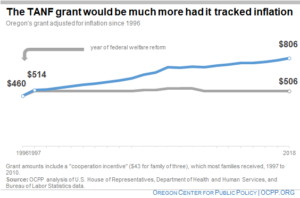
Indeed, families must be poorer to qualify for assistance today than 20 years ago. The program’s $616 “gross income limit,” the maximum allowable before certain deductions and exemptions, was established in July 1991 and has remained frozen at that level ever since. If the eligibility amount had kept pace with inflation, a family of three could earn about $1,001 per month in 2011 (65 percent of poverty) and still qualify for assistance. The program’s failure to keep income eligibility standards updated for inflation is one of the reasons TANF today serves far fewer poor families than it did when the program began.
Most families entering Oregon’s TANF program have no earnings and very few, if any, assets.
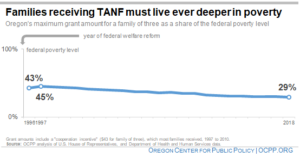
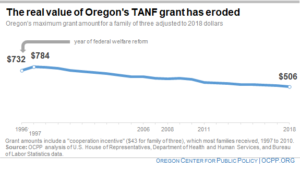
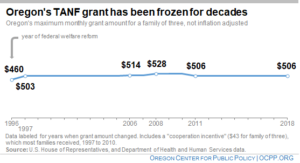
The cash assistance that families receive is minimal. The maximum grant for a family of three is $506 per month, which amounts to just 30 percent of the federal poverty line. In other words, if the grant were tripled, the family would still not escape poverty.
Currently, there is a 60-month lifetime limit on the help that families can receive, though assistance can last longer in certain hardship cases. In July 2010, the average period of lifetime TANF participation for a family of three was 24 months.
In 2007, in response to 2005 changes in federal law, the Oregon legislature overhauled the TANF program. As part of the redesign, lawmakers tightened time limit and work activity rules, while simultaneously increasing access to employment and social services to help parents find work.
In the 2011 legislative session, the Governor proposed structural changes and cuts to TANF that would heap greater hardship on tens of thousands of Oregon’s poorest kids. If implemented, the changes would have slashed Oregon General Fund and Lottery Funds support for TANF by a total of $67.1 million. According to the Department of Human Services, a likely result of the Governor’s proposals would have been families becoming homeless and more children ending up in the costlier foster care system.