
Oregon spent nearly $11 billion over the past decade on kicker tax rebates, with more than 62 percent of that amount going to the richest fifth of Oregonians, according to the Oregon Center for Public Policy. The research institute’s analysis comes as Oregon prepares to issue a new round of kicker rebates with the start of tax filing season.
“The kicker remains very costly in terms of lost opportunities,” said Tyler Mac Innis, a policy analyst with the Center. “Instead of making child care, health care or housing more affordable for Oregonians, we spent huge sums on a tax rebate that favors the most well off.”
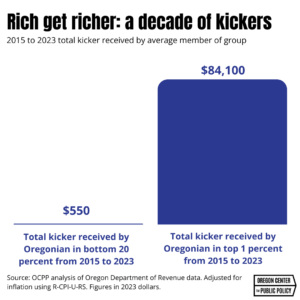
The skewed nature of the kicker is even more evident when considering how much people with different levels of income received from the tax rebate over the past decade, Mac Innis said. From 2015 to 2023, the average member of the richest 1% of Oregonians received about $84,100 in kicker rebates in inflation-adjusted figures. By contrast, the average member of the lowest-earning 20% of Oregonians collected about $550 over the same period.
The kicker is a tax rebate triggered when personal income tax revenue collections are 2 percent or more above what state economists predicted two years earlier, prior to the start of the budget period. Each of the five budget periods from 2015 to 2023 saw the kicker triggered, an indication that, “the kicker is based on an absurd formula requiring state economists to predict with great precision how the global, national, and state economies are going to perform over the next two years,” said Mac Innis.
The analysis by the Center does not include the kicker set to be issued during the upcoming tax filing season. That kicker, according to state economists, will total about $1.4 billion.
Adding up the cost of the tax rebate over the past decade gives a sense of what the state could accomplish if it were to spend even a portion of kicker dollars in a different way, according to Mac Innis. He noted that the amount that the richest 1 percent together have received from kicker rebates over the past decade, about $1.5 billion after adjusting for inflation, is more than what Oregon might need to seed a fund that would pay to fight wildfires on an ongoing basis.
Another point of comparison offered by the Center concerns the cuts to Supplemental Nutrition Assistance enacted by Congress in July. Oregon will need nearly $3 billion to prevent Oregon families from losing nutrition assistance as a result of the cuts over the next three budget periods. That’s slightly less than the $3.2 billion in tax rebates that the richest 5 percent of Oregonians have received over the last three kickers.
“There is only so much state revenue to go around,” Mac Innis said. “We can spend it on a tax rebate that mainly flows to the most well off, or we can use it to address the real problems that Oregonians are facing.”