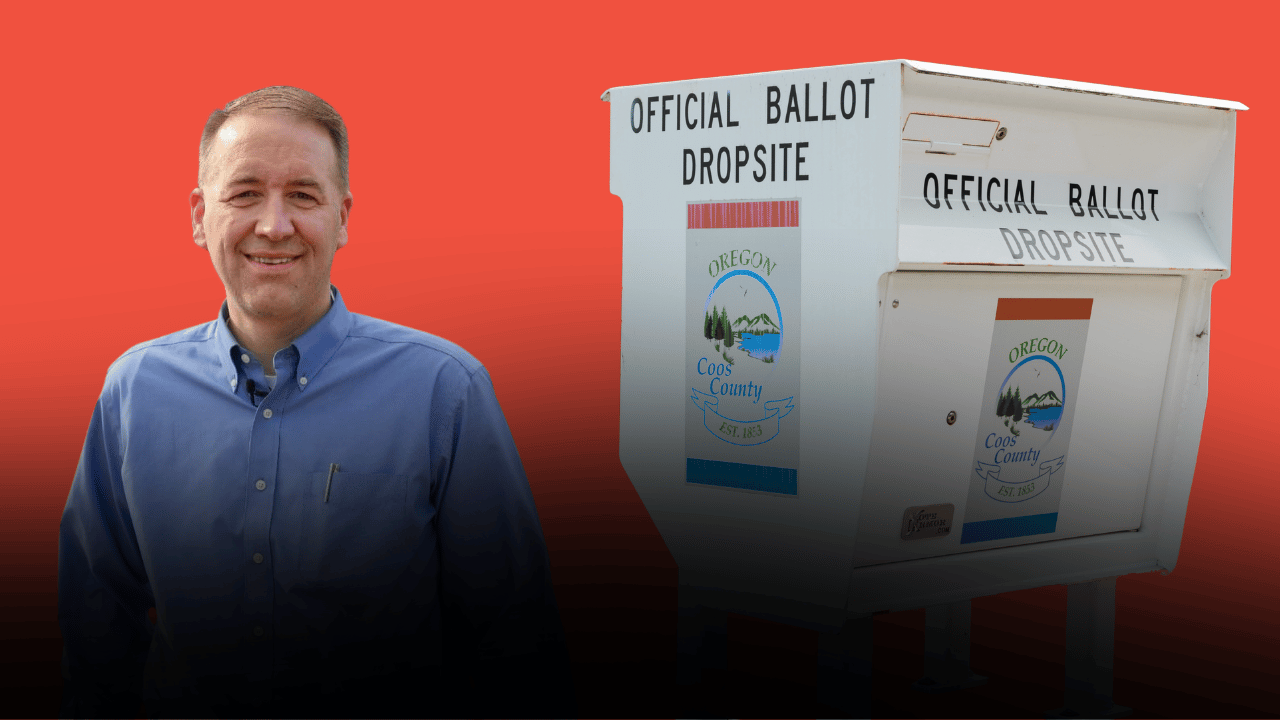
In this episode, Alejandro Queral speaks with Oregon Secretary of State Tobias Read, the state’s chief elections officer, on efforts by the Trump administration to make it harder for people to vote. These efforts include the SAVE Act, which imposes costs and barriers on voters, as well as changes to the rules by which the U.S. Postal Service postmarks mail, which has big implications for Oregon’s vote-by-mail system. They also discuss the influence of money in politics, especially at a time of extreme economic inequality.
Listen to prior episodes of the show
Follow Policy for the People on your favorite podcast app



Transcript
[We make this transcript available for your convenience and to increase the accessibility of our content. The transcript was generated by software and was slightly edited for clarity. If you are able to, we encourage you to listen to the recording.]
Juan Carlos Ordonez (host): It’s been said that having a democracy is more than just having elections. It takes having an informed and engaged citizenry, and that’s certainly true.
And yet it’s also true that elections, where the results reflect the will of the people, is at the core of what it means to live in a democracy. Oregon has long been at the forefront of making it easier for people to exercise their right to vote. As early as the 1980s. Oregon began experimenting with vote by mail and local elections, and in January 1996, Oregon became the first state in the nation to conduct a general election totally by mail to fill a vacancy in one of Oregon’s two seats in the US Senate.
Research shows that vote by mail increases turnout. It makes it more likely that eligible voters exercise the right to vote. Right now, however, Oregon’s long standing and effective system of vote by mail is under attack. At the end of March, President Trump signed an executive order instructing the US Postal Service to only send mail in ballots to people who have been deemed eligible by the administration.
That comes on top of changes by the US Postal Service to the rules by which it postmarks mail. The Postal Service said that it will now apply postmarks at central processing facilities, and not necessarily at the local offices where the mail is dropped off. This means that Oregonians voting by mail may have their ballots disqualified, even when they filled out and mailed their ballots on or before Election Day.
And this is only one of several challenges facing our voting system. To discuss the threats facing our election system, my colleague Alejandro Queral, executive director of the Oregon Center for Public Policy, spoke to the person ultimately responsible for safeguarding our elections here in Oregon; Secretary of State Tobias Read. He was elected to that office in 2024. Prior to that, Tobias Read held the position of Oregon Treasurer, and he has also served in the Oregon Legislature.
In their conversation, Alejandro and Secretary Read discussed how Oregon is responding to the Trump administration’s attacks on our election system, the impact of money on our democracy, and more. Here is their conversation.
Alejandro Queral: Secretary of State Tobias Read, welcome to Policy for the People.
Tobias Read: Thanks for having me.
Alejandro: As Secretary of State, you are the chief elections officer. And President Trump has made it clear that he wants to see a much more restrictive election system from stricter identification requirements in order to register to vote, to doing away with mail in ballots.
So what keeps you up at night?
Tobias Read: Yeah, well, all of this, I mean, I think there are just so many examples of how the president is exceeding his constitutional authority. For one, we’ve beaten him in court a couple of times already on this. In the latest executive order, I think we have another opportunity to do that because he does not respect American voters or the Constitution.
We have just a fundamental difference in values, he and I, because I think we are stronger and better when more eligible people get to participate and hold government accountable and make their voices heard. And that’s what we do in Oregon. We run safe, accurate, fair elections in Oregon. We have, for a very long time and we are really proud the way we do that, because it allows people to fit voting into their otherwise complicated and busy lives.
Your ability to participate in a constitutionally guaranteed right, should not depend on your economic status. You shouldn’t have to take time off of work, or get a babysitter or stand in line just to vote. And so Oregon, I think, has as long been at the forefront of trying to move us in the direction of more people participating, more people having a stake in what we’re doing.
And that’s what we’re going to continue to do. So the president can say whatever he wants, and he does, but he can’t change the Constitution. And we will continue to defend our authority every single time.
Alejandro: You are referring to President Trump’s, I think, March 31st executive order, in which he instructed the U.S. Postal Service to only send mail in ballots to people who have been deemed eligible to vote by the administration. So can you tell us more about what this executive order does and what is the state of Oregon’s position regarding the executive order?
Tobias Read: I think you gave a great summary of it. The only thing to add to it is that in following the determination of who is eligible and who is not by the federal government, a role that they have not been able to, when they don’t have the authority to have the kind of information and to have demonstrated again and again their inability to protect that kind of sensitive information.
The executive order also instructs the Postal Service about who they can and can’t send ballots to. So all of these things are, we believe, unconstitutional. That’s why we’re with more than 20 other states challenging that executive order. It’s just the latest one. We challenged his first executive order near the beginning of the second term.
And we also, refused to comply with his demand to send all of our voter data, all of the private, sensitive information of Oregon voters to the federal government, a case that was then thrown out by a federal judge in Eugene. They’re since determined to appeal that, but we’re really confident in the argument we’re making.
So, again, it’s just an administration that does not have the same values as we do about making it convenient for eligible people to participate and to hold the government and politicians accountable. We’re not going to take that lying down.
Alejandro: How likely is it that this latest executive order could impact the May primaries?
Tobias Read: It’s impossible because the executive order says this list has to happen, 60 days out from the primary as we record this year in, in the early part of April, we’re inside that 60 day window.
So even if we thought it was a good idea and was legal, we couldn’t do it. And it’s just another example why you do not change the rules in the middle of a game, a campaign is not a game, but it is something like a game in the sense that you agree on the rules. And then you engage in the contest.
Alejandro: Now, on the congressional side, Republicans in the House and at the behest of the president, have passed a Save America Act, which, among other things, the legislation would require citizens to show documents like a passport or a birth certificate when they’re registering to vote. The Trump administration claims this legislation is needed to prevent mass voter fraud by non-citizens.
What do you think about this bill, and what would be the effect on Oregonians if it were to become law?
Tobias Read: It’s functionally a poll tax. Thinking about that, whether it’s actual money, in the case of someone who has to get a passport. You know, something around half of the people in this country do not have a passport already. And that’s a significant cost, $165, $190. If it’s not actual money, it’s a tax on time. Someone who lives a long distance from an elections office having to show up, in person. Someone who changed their name after a marriage or a divorce, having to get additional data, all for a problem that does not exist.
There are studies nationally again and again that show that the voter fraud is vanishingly rare. It does not affect the outcome of any elections. Again, lots of national studies, but the one that was in Oregon that I think is especially relevant here, covered about 20 years and 60.9 million ballots cast. In the analysis of those ballots, there were 38 cases of improper voting found.
That’s 38 too many. But, it’s pretty rare. I mean, that’s easy math. Less than 1 in 1,000,000. And I haven’t looked lately, but as I recall, that’s, you’re more likely to be struck by lightning. So this is not something that is affecting outcomes of elections. We’re always trying to raise the floor. And get more secure.
But it is not something that should cause us to be willing to put up barriers and make it harder and more expensive for eligible Americans, eligible Oregonians, to vote so they can hold politicians and government accountable.
Alejandro: Right. And so if it does become law, in that eventuality, what levers or tools would your office have in order to push back against the legislation’s requirements, or is Oregon out of luck at that point?
Tobias Read: Well, I think we would push back. One, I feel very confident given our senators. Senator Merkley and Senator Wyden, who are pushing back, who understand the implications of this, understand why it’s unnecessary, reckless, expensive, all of those sorts of things. And we haven’t even talked, by the way, about the cost that this imposes on county governments, cash strapped elections officers who are in the midst of dealing with all kinds of other things, real threats, not this imaginary one that the president seems to conjure.
But if that were to pass, I think we would push back legally as well, because we don’t think that it can stand. We will use every tool that we can. And in the meantime, Oregonians have to be confident, they should be, that we are going to continue to hold elections that allow people to vote, and have the confidence in those in the results.
Alejandro: Well, another issue that threatens to disrupt our elections, and maybe this one could have an impact on the May primaries is the new U.S. Postal Service’s post-marketing rule changes. What are these changes? And could they affect the ability of Oregonians to cast their votes?
Tobias Read: They could. I appreciate you raising that. It’s a problem because the post office has cut services, and changed their operations. So if you happen to live somewhere in Oregon, that is more than about 50 miles from Portland, your mail is very likely going to Portland before it gets postmarked and processed and eventually sent to its destination.
So imagine you’re a voter who lives in Medford and you’re mailing in your ballot. You can’t count on it being postmarked until it gets to Portland and then gets back to the elections office across the city and in Medford. That has an important implication because that ballot has to get to the elections office to be postmarked by election.
It has to get to the elections office by no later than seven days after the election presently. So whatever else happens with the Supreme Court case th they’re considering, we are really trying to encourage people to vote as soon as they’re ready, make their decisions. And if there’s any way to get their ballot to a county drop box, that’s the best way to go.
Because that does not require the Postal Service to have a role at all. If you need to use the mail, that’s fine, but please try to do that at least a week ahead of the election. And if you need the mail, it’s, you know, a week or less till Election Day, go to the post office, go to the counter and ask that person to put a postmark on the ballot by hand.
That will improve the chances of us getting it in time and having it eligible to be counted. I am just of the fundamental opinion that if you’ve cast a ballot before election night, your ballot is legal. It’s gone through all of the same security checks, all the same protocols, and it should count. I hope the Supreme Court sees it the same way.
Because we’re better off, as we’ve said a couple times already, when more people get to have their say. But ultimately, whatever they decide, we want people to vote as soon as they’re ready. Use the ballot drop boxes if you can.
Alejandro: What is your office or other county elections office planning to do to alert voters of this need to vote early?
Tobias Read: We’re talking everywhere we can. One of the many reasons I’m glad to be talking with you. We’re talking to every county elections office to try to get those messages out. And I think every one of us as an individual has a network that we can talk to, to our friends and family or neighbors or coworkers, people we might be standing in line with at the grocery store.
This is one of the hallmarks of our country. There are big decisions to be made in this May and November elections, and we don’t want anyone to miss out. So, we’re using every channel we can, but we can always use help to get that message to people. I mean, we should be proud of how we’ve done it in Oregon, making it convenient for people to vote.
But for all of the successes we’ve had on that, there’s still 25% of people who are registered and eligible who end up not voting for whatever reason. So all of us can take some responsibility, be on offense and help people remove those barriers and get their ballots in and make sure that their voices are heard.
Alejandro: Yes. And some critics have argued that perhaps, Oregon has made it too easy to register to vote. I don’t subscribe to that criticism
Tobias Read: Nor do I.
Alejandro: But the criticism is out there. And, you know, one of the reasons for this criticism is that under Oregon’s voter law, one is automatically registered to vote when you go to the DMV to get your driver’s license.
But in October of 2024, it was revealed that over 1500 people were registered to vote without having provided proof of citizenship when obtaining their license. The governor called for an audit. And to be clear, as you mentioned, you know, the number of people relative to the number of people that are registered to vote, the number of people that vote illegally is very, very small, a fraction that probably doesn’t have an effect on the election.
But I wonder if you can tell us a little bit more about what happened and what is Oregon doing to prevent this type of error from happening in the future?
Tobias Read: Yeah, this is an example of what I would say is a good policy that was poorly executed. And we went through a significant audit process and found a number of places where we can make changes, and we have made those changes.
So the risk of that kind of error is much, much less than it was. We’ve instituted a number of things that change the way those processes happen, from random sampling, going back to making sure that those registrations get a second look. Regular visits from our elections team, our audit team and county clerks teams to the DMV offices to make sure that those things are being followed through.
And then an outside audit that followed up on that found that those tools, those steps are already in effect. We’ve taken a comprehensive look from the top to bottom of the rules that govern that program and reworked a lot of those rules. So, I continue to think that the people can feel confident about our systems.
And again, we want to make it convenient for eligible people to participate in our system. That’s what these changes have done. And I think Oregonians can feel safe about that.
Alejandro: Right. And it seems reasonable to assume that when we’re trying some new things, you know, we’ll make some mistakes and we’ll correct them and we’ll learn from those mistakes and improve the system.
Which is why states are considered the laboratories of democracy. Right?
Tobias Read: That’s right. That’s what Louis Brandeis said. Yeah. And listen, I hope no one mistakes me. There was nobody less happy about those mistakes than me. It frustrates me, to no end, because these things matter. And we have to earn the confidence of Oregonians when we are not following through, when we’re not paying attention to rigor and detail and execution, the confidence that Oregonians have in our systems suffer.
That’s why we take it really seriously. That’s why we are following up. That’s why we are making those changes to our system and insisting that they be followed through with audits, with visits, with tacit communication with the DMV. Data matters and execution matters, and we are not giving up on any of that.
Alejandro: That’s good to hear. Let’s shift gears and talk about money and politics, because this is another area which we’ve been trying to get right. And we don’t see this quite there yet. In March, a New York Times analysis showed that the amount of money that billionaires are pouring into our elections is going through the roof, and it’s increasing their political power.
So what are your thoughts on the influence of money in politics?
Tobias Read: (laughs). Yeah, that’s a very broad question. It’s too much is the short answer. And that’s one of the reasons I’m really happy that the Oregon Legislature decided to pass, campaign finance reform and institute limits. It’s a hard thing for us to implement.
It’s difficult, but we are really committed to it. And that’s why we worked so hard on the bill that the legislature passed. We hope that the governor’s going to sign. That gives us the ability to push those regulations through, because this is what’s consistent with our values. We don’t want anyone to be able to buy an election.
No, the voice of the wealthy person should not count any more than the voice of every other person in Oregon. We all get one vote if we’re eligible, and we all should have that same kind of influence. So, we’re encouraged by that step, and we’re committed to making sure that we implement this, in a way that Oregonians can be proud of. And that actually works.
Alejandro: But to be clear, I mean, for many years, Oregon has been one of the few states with no limits on how much money one can give to a candidate. Right. And in 2024, the legislature passed some campaign finance reform that was supposed to go into effect in 2027. This bill that you were referencing was supposed to, fix some technical, you know, fix some technical issues that they had in terms of the campaign contributions.
But some critics have argued that the bill actually weakened those limits. So can you talk a little bit more about what the legislation does? Does it help or hurt efforts to curb the corrupting power of money in politics?
Tobias Read: I think it does help. It gives us the ability to institute those limits on its original time frame at the end of this calendar year 2026.
So on January 1st, 2027, those limits will be in place. That’s a really good thing for us. The other elements of the bill are challenging in terms of technology, some inconsistencies that were in the original legislation. So the bill that was passed in this session, gives us a chance to do the rigorous, difficult technology implementation that’s going to be required.
What we don’t want is for this to add to the same kind of failed implementations that have plagued Oregon and other aspects of our operations. But what people really need to know is that I’m committed to this as long as I’m Secretary of State, if I see loopholes, I’m going to close.
I will come back to the legislature to advocate for additional clarification legislation, if that’s necessary. But I’m excited that we get to start right now by instituting those limits. It’s going to be a sprint between now and the end of this year to get all of those things in place. But now we have, the governor signs this bill, will have the clarity and we’ll have some ability to follow through in a way that I think gives Oregonians the chance to have a system that meets with their values and the intent that we all share.
Alejandro: What are or who are some of the critics, not just of this particular bill that passed in this last legislative session, but writ large around campaign finance reform? In other words, are there advocates for having no limits on campaign contributions? And who are those voices?
Tobias Read: Well, sure. I think there are people who say that. I think, you know, if you’re making that case, you would just say that Oregon, having not had any limits, one thing that Oregon has been good on is, is being transparent. And the good news is that we’re going to continue to be transparent in this, and this legislation will continue to make it easy for people to see where dollars are going and where they came from.
Alejandro: Do you think that with technical fixes, this legislation will solve our problems, or is there more work to do after that?
Tobias Read: So I remember when I was in the legislature, early on, we passed a bill that had to do with state taxes on natural resource based estates, it was super complicated. They’re talking about a, you know, Christmas tree farm or fishing business. And almost every session after that came back saying, I think we got it figured out this time.
There are going to be changes that we have to make. They’re going to be refinements. They’re going to be fixes. No other state has tried to do what we’ve done here. So I’m sure that we’re going to have more work to do and improvements. That’s just the way our system works.
But I think what people should be clear about is that we are committed to doing this. We’re committed to staying in it. We’re committed to paying attention to the details and the, you know, implications and downstream effects known and unknown so that we get them right and continue to improve.
Alejandro: So if you were to pick the next thing that needs to happen, in order to keep moving in the right direction with respect to campaign finance reform, what would it be?
Tobias Read: It’s funding. It’s the challenge of implementing the technology that is in place. We looked at the dollars that are spent on this, other states that didn’t follow through with their intent.
Arizona is a good example. They didn’t follow through on their funding, and now they’re out of compliance with the bill that they passed. So we’ve got to make sure that the legislature does not succumb to a temptation to wash their hands and say, we passed the bill, we’re done. We got to follow through on that implementation.
That takes funding. It takes sustained effort. We’re ready to go and hope the legislature will support us and join us.
Alejandro: Great. Well, lastly, I want to talk more broadly about democracy and economic inequality, particularly, you’ve been twice elected to statewide office, once as treasurer, now as secretary of state. So I imagine you have some views on this issue.
So let me set it up this way. Income and wealth inequality have been growing over the last 40 plus years, are now reaching extreme levels. Do you think we can have a truly functioning democracy that is responsive to the needs of regular folks, when so much power is in the hands of the wealthy few?
Tobias Read: I think talent is distributed equally, it’s opportunity that’s not.
And a big part of the government’s role is to make sure that everyone has the opportunity to take them as far as their talents will go. And that plays out in lots of different ways. But I think everyone should have that expectation. Everyone should be in a position to demand that from government.
In many ways it plays out in different policy areas. But we’ve got lots of work to do to make sure that the resources are there so that people have that opportunity. In the long run, the things that really make a difference for a state are in education, in innovation and in infrastructure.
When we don’t have the resources to invest in those things that serve people, we’re not doing a good job, and we can’t get to that before we make sure that people have the ability to meet their basic needs. The agenda, I think we should be able to agree on centers on those things. Can people meet their basic needs?
Are we giving people the opportunity to aspire greatly, and have a chance to achieve their dreams? That it plays out in so many different ways. But that’s the stuff=t that motivates me. It’s what animates the work I get to do. It’s what is in my head as secretary of state, and it was as treasurer.
And, I don’t think I’ll ever get away from that.
Alejandro: What do you think are perhaps the key policies, one or two key policies that would move us in the right direction to achieve those goals, to make sure that people are able to afford their basic needs and that the state can provide the kind of supports that those families that are currently struggling, in order for them to have a good life.
Tobias Read: I don’t think you can ever get away in this representative democracy that we’re fortunate to have from the idea that people have to be able to vote. Everyone who is eligible needs to have that opportunity. We need to make that as convenient as possible so we can hold politicians accountable. You know, it’s easy to say things, if you’re not facing a real election.
We see that in other countries around the world. I was just listening to a podcast this morning about Hungary, which they described as a competitive, authoritarian regime. It has the, you know, the display of elections, but they’re not real. And I think when people in office don’t take elections seriously, that’s when things get dangerous and we move away from that.
So it’s hard for me to get past that. That’s my job now, is to defend democracy and make sure that, you know, my job is to count votes. The job of voters is to vote. And that partnership has to, I think everything stems from that. Then we get into the questions of what kind of a community do we want to live in?
What programs and services does that require? How do we run them effectively and efficiently and then get to the question of how we share the cost of those things? But fundamentally, this is a democracy that requires systems that encourage participation and to take them seriously.
Alejandro: Great. Well, Secretary of State, Tobias Read, thank you very much. Thank you for joining us. And, we hope to have you again soon.
Tobias Read: It’s my pleasure. I’d be glad to come back. Thanks for having me.