
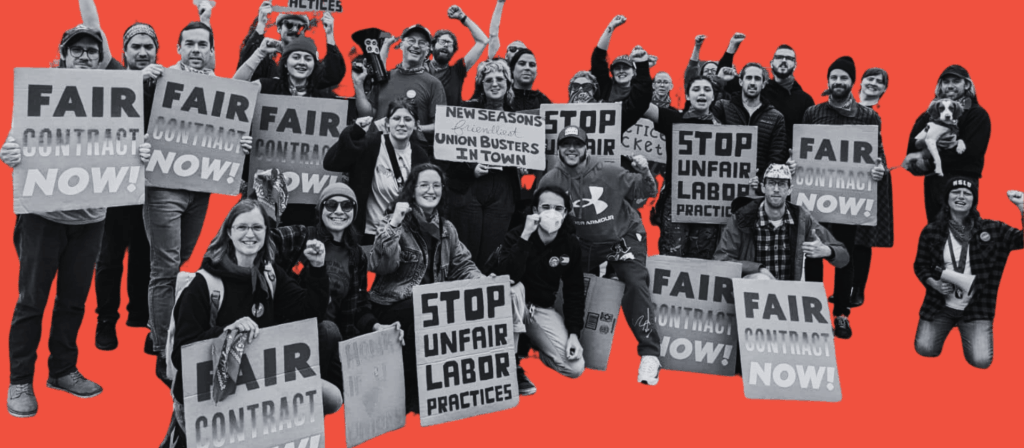
The desire of Oregon workers to form unions remains strong, despite the significant barriers they face in achieving that goal. Unions allow workers to join forces in demanding better pay and working conditions. Unionized workers enjoy wages 12.8 percent higher than non-unionized workers, as well as greater job protections.[1] Given the advantages that unions provide to workers, it should not be a surprise that a large majority of the public view unions favorably. Since the days of the pandemic, Oregon has seen increased labor organizing activity, a hopeful sign.
Despite workers’ favorable disposition toward unions and desire to join one, the share of workers actually belonging to unions remains much lower. In 2025, 15.1 percent of Oregon workers were union members, not much different than the level a quarter of a century earlier. Although the Oregon figure is higher than the national figure, it is far below the 68 percent of the population that view unions positively.[2]
The disconnect between the desire of workers to join a union and the reality on the ground largely reflects a broken federal labor law regime that fails to protect workers’ right to organize. While federal labor law reform remains an urgent need, there are steps that Oregon can take to remove some of the barriers that workers face when it comes to forming or joining a union.
Union coverage in Oregon remains stagnant, even as it tops the national average
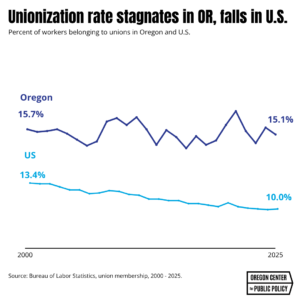
Despite the increased labor activity in recent years, the share of Oregon workers that are members of unions have been more or less unchanged since the turn of the century. In 2000, about 15.7 percent of workers were members of a union. In 2025, that figure stood at 15.1.[3] Although the figure has been higher and lower some years, the long-term trend is one of stagnation. In the case of the private sector, the figures are worse still. In 2025, 9.2 percent of Oregon workers in the private sector belonged to unions.[4]
Although the share of Oregon workers belonging to unions has stagnated, that result still looks good relative to the national trend. In 2025, union membership at the national level stood at 10 percent, a significant drop from the 13.4 percent share in 2000.[5] The most recent figure was the second lowest reading during that time. Not only is union membership lower today than at the start of the century, it is well below the record set in 1945, when union membership stood at 33 percent of all workers in the U.S.[6]
Worker organizing has been at elevated levels since the pandemic
By several measures, worker organizing has been vibrant since the days of the pandemic. In 2025, these measures either notched record highs or remained above pre-pandemic level. That’s significant, given that the pandemic years saw a surge in organized labor activity.
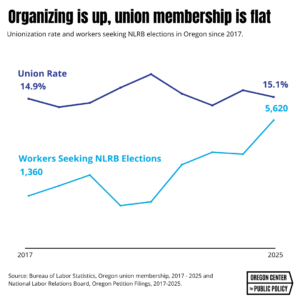
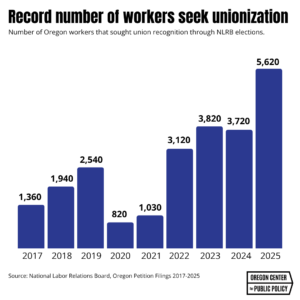
In 2025, more workers sought union recognition than ever before. Oregon saw a historic high of more than 5,600 workers pushing for unionization.[7] This constituted a 47 percent increase from 2023, which also marked a record high in terms of the number of workers seeking union recognition. To put the 2025 figure in context, the years prior to the pandemic would, on average, see under 1,700 workers seeking union recognition.[8]
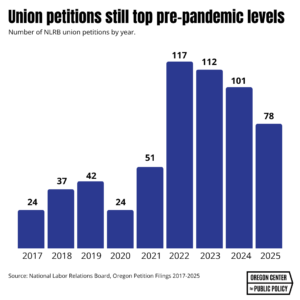
While petitions for union elections have not surpassed the 2022 peak, they are still higher than before the pandemic. Petitions occur when workers at a job site file with the National Labor Relations Board (NLRB) to hold an election where workers vote to have their union recognized as the exclusive collective bargaining representative.[9] The highest number of petitions to the NLRB for union elections occurred in 2022, when Oregon workers filed 117 petitions. In 2025, Oregon workers filed 78 petitions. This is well above pre-pandemic levels, where average petitions hovered around 32 a year.[10]
In this respect, organizing in Oregon appears stronger than in the U.S. as a whole. In 2024, petitions for union elections in the U.S. increased by 18 percent from the previous year. That same year saw about 135,000 workers seeking union recognition — a more than 30 percent increase in workers seeking union recognition from the previous year. Although 2025 saw a dip in both NLRB elections and workers seeking union recognition, petitions remained slightly above pre-pandemic levels, while the number of workers fell back to below the pre-2020 figures.[11]
What explains the higher level of organizing in Oregon?The higher levels of organizing in Oregon compared the nation as a whole may reflect the higher level of union density in Oregon. Oregon ranks seventh among states in the share of workers belonging to unions.[12] Public sector workers in Oregon, in particular, have high levels of unionization, with about 47.4 percent belonging to a union, compared to 32.9 percent nationally.[13] Higher union density may make workers more aware of the benefits of unions or see unions as normal part of working life and be more open to joining unions. In addition, unions that have the ability to sustain themselves may be better positioned to support new worker organizing.[14] |
Employer hostility and a broken federal labor law system hinder organizing
Many employers engage in campaigns designed to intimidate workers and discourage unionizing. Examples include captive audience meetings – meetings held by the employer to convince workers to not join a union, usually under implied threats to employees.[15] Employers sometimes illegally fire workers to discourage union organizing. Employers also threaten workers with loss of wages and benefits or may make promises regarding higher benefits or wages if workers don’t unionize.[16] Workers may also experience intrusive surveillance, such as the monitoring employee’s social media accounts and employers using cameras to spy on employees.[17] Researchers find employers spend over $400 million every year to defeat workers union efforts.[18]
Oregon workers are no strangers to the intimidation tactics used by employers.[19] In 2024, for example, Northwest Medicine United, the union that represents physicians and other advanced providers, filed charges against Providence Health & Services, alleging that the company fired a physician assistant in retaliation for their work in organizing medical providers at the health system’s urgent care clinics.[20] In 2025, KGW staff began the formal process of seeking union representation. During that organizing campaign, KGW allegedly used intimidation tactics such as mailing anti-union letters to the homes of employees, having managers give out “vote-no” letters to employees, and telling workers that unionization would prevent staff from receiving their yearly merit raises.[21]
The prevalence of intimidation tactics used by employers to deter unionization efforts is the result of a federal labor law system that fails to adequately protect workers’ right to organize. Researchers find that employers are charged with violating federal labor law 41.5 percent of the time during union election campaigns.[22] Employers face little to no penalties when violating labor law. If an employer is found to have illegally fired or demoted a worker for exercising their rights, the employer often is only required to pay back wages and benefits. This amount can be reduced by the amount the worker “earned or could have earned” while the case was ongoing.[23]
The fact that employers often face only a slap in the wrist for labor law violations is not the only problem. Even when they succeed in forming a union, workers still have to jump through hoops to reach a first contract after elections. Although employers are required to bargain in good faith with workers, the NLRA does not require that unions and employers reach an agreement. Studies have shown that 63 percent of unions failed to reach a first contract within one year of winning, with delays linked to employer prohibited anti-union behavior.[24]
Worse still, some workers have no right to organize under federal law. Certain categories of workers – including farmworkers, domestic workers, and gig workers – are not covered by the National Labor Relations Act.[25] From the outset, the NLRA failed to extend the right to organize to agricultural and domestic workers — a decision rooted in racism in American society at the time. Lawmakers from the Jim Crow South, concerned that empowered Black workers would refuse to continue to work in white-owned fields, factories, and kitchens, fought to ensure agricultural and domestic workers were excluded under the original law. That unequal treatment has remained on the books for nine decades.[26]
Removing the barriers that workers face in joining and winning union recognition could lead to substantial growth in union membership.
Oregon can help make it easier for workers to join unions
Federal labor law needs serious reform. More than two-thirds of Americans approve of labor unions and believe that a stronger union influence ensures that more people reap the benefits of our economy.[27] At the same time, researchers find that “50 million nonunionized workers would join a union if they could.”[28] And yet the share of workers belonging to unions hovers near all-time lows, a disconnect that speaks to a broken federal labor law regime. Important reforms have been introduced in Congress, including the Protecting the Right to Organize Act (Pro Act).[29] If enacted, these reforms would go a long way in removing the barriers that workers face when it comes to workplace organizing.
Separate from the federal reforms that are needed, Oregon can take steps to strengthen worker power. These reforms include:
Extend bargaining rights to workers excluded from the NLRA. Granting state bargaining rights to workers excluded from the National Labor Relations Act would enable more workers to form and join unions. More than 116,000 Oregon agricultural and domestic workers — disproportionately immigrant and workers of color — are not covered by the NLRA and lack long-established organizing rights.[30] Gig workers, generally considered independent contractors, are also excluded from NLRA protections. They too are more likely to be workers of color.[31] To address this, Oregon can develop state-level organizing protections for workers and require employers to bargain in good faith. It can also speed up the process by facilitating union recognition through the process known as majority card check, where the union is automatically certified if 55 percent or more of employees sign union authorization cards. California adopted such a measure for agricultural workers in 2022.[32] This would not only enable excluded workers to form and join a union of their choice, but reduce the risk of employer anti-union campaigns.
Establish industry wage boards. Wage boards, also known as Workforce Standards Boards, not only can lead to better pay and working conditions for workers, but also help change employer opposition to unions. Wage boards are entities established by the state or local governments that recommend or set standards for pay and working conditions for an entire industry. By setting a minimum standard that all employers have to meet, wage boards reduce the ability of businesses to compete on the basis of poor wages and working conditions, while creating an entity where both employers and workers discuss and negotiate industry standards. These circumstances reduce incentives for employer opposition to worker organizing drives. For example, sectoral campaigns to raise the minimum wage in airports not only increased their base pay, but also helped 30,000 airport workers unionize.[33]
Implement just cause. Oregon should enact “just cause employment,” a policy requiring that workers can only be fired for valid reasons, such as misconduct and bona fide economic necessity. Currently, only a minority of workers enjoy just cause protections. This includes public sector employees, unionized workers, and company executives or other workers who have negotiated such a standard for termination. Most private-sector workers, however, are considered “at-will,” meaning they can be legally fired without warning or explanation. Under at-will employment, employers can terminate employees during union election drives and face minimal consequences. Implementing just cause employment standards can significantly change this. This fair and transparent standard restricts an employer’s ability to arbitrarily dismiss employees, particularly if the motivation is to discourage unionization efforts. By eliminating this unnecessary power imbalance in the workplace, just cause enables workers to more effectively take collective action.[34]
Conclusion
Worker organizing remains vibrant in Oregon, demonstrating the desire of workers to improve their pay and working conditions by joining unions. Employer hostility and a broken federal labor law regime, however, are barriers to workers gaining union membership. In the absence of federal action, Oregon lawmakers should enact reforms that can help workers in their efforts to organize the workplace.
[1] Celine McNicholas, Margaret Poydock, et al., Unions aren’t just good for workers – they also benefit communities and democracy, Economic Policy Institute, August 20, 2025.
[2] Megan Brenan, Labor Union Approval Relatively Steady at 68% in U.S., Gallup, August 28, 2025.
[3] US Bureau of Labor Statistics, Union affiliation of employed wage and salary workers by state, Oregon. Annual estimates for 2025 are 11-month averages that exclude October. Data for October 2025 were not collected due to the federal government shutdown
[4] Hirsch, Barry T., David A. Macpherson, and William E. Even (2026). Union Membership, Coverage, and Earnings from the CPS.
[5] US Bureau of Labor Statistics, Union affiliation of employed wage and salary workers by state, United States.
[6] Lawrence Mishel and Jessica Schieder, As union membership has fallen, the top 10 percent have been getting a larger share of income, Economic Policy Institute, May 24, 2016.
[7] The figure represents the highest number of workers seeking unionization since the start of the series.
[8] National Labor Relations Board, Recent Charges and Petitions, 2007 – 2025 and OCPP analysis of National Labor Relations Board, Recent Charges and Petitions, 2007 – 2025
[9] National Labor Relations Board, Representation petitions – RC.
[10] National Labor Relations Board, Recent Charges and Petitions, 2007 – 2025 and OCPP analysis of National Labor Relations Board, Recent Charges and Petitions, 2007 – 2025
[11] Ibid.
[12] OCPP analysis of 2025 union stats data.
[13] Hirsch, Barry T., David A. Macpherson, et. al, Union Membership, Coverage, and Earnings from the CPS.
[14] Oregon statute ORS 663.127 allow union security clauses. Union security clauses allow unions to collect agency fees, from employees covered by a union contract but who do not want to be union members, to cover the cost of representation. This allows unions to sustain their operations. See Jennifer Sherer, Rights to unionize and collectively bargain: State solutions to the U.S. worker rights crisis, Economic Policy Institute, February 17, 2026.
[15] National Labor Relations Board, Board Rules Captive – Audience Meetings Unlawful, November 13, 2024.
[16] National Labor Relations Board, Employer/Union Rights and Obligations.
[17] Kate Bronfenbrenner, Testimony before the United States House Committee on Education and Labor, House Committee on Education and Labor, September 14, 2022.
[18] Celine McNicholas, Margaret Poydock, et al., Employers spend more than $400 million per year on ‘union-avoidance consultants to bolster their union-busting efforts, March 29, 2023.
[19] Heidi Shierholz, Celine McNicholas, et al., Workers want unions, but the latest data point to obstacles in their path, Economic Policy Institute, January 23, 2024.
[20] Lucas Manfield, Providence Accused of Retaliating Against Union Drive, Willamette Weekly, May 12, 2024. Pacific Northwest Hospital Medicine Association changed their name to Northwest Medicine United in 2025.
[21] Don McIntoch, KGW workers stand firm against anti-union campaign, Northwest Labor Press, March 5, 2026. a NRLB filings show that KGW workers began their process for union recognition in December 2025.
[22] Heidi Shierholz, Celine McNicholas, et al., Workers want unions, but the latest data point to obstacles in their path, Economic Policy Institute, January 23, 2024.
[23] Margaret Poydock, Celine McNicholas, et al., Shortchanged—weak anti-retaliation provisions in the National Labor Relations Act cost workers billions, Economic Policy Institute, April 22, 2021.
[24] Celine McNicholas, Margaret Poydock, et al., Workers are winning union elections, but it can take years to get their first contract, Economic Policy Institute, May 1, 2023.
[25] Josh Jacob, Avenues for Gig Worker Collective Action After Jinetes, Columbia Law Review, Vol. 123, No. 7, 2023 and Tyler Mac Innis and Janet Bauer, Oregon Should Ensure All Workers Have the Right Organize, Oregon Center for Public Policy, August 23, 2023.
[26] Tyler Mac Innis and Janet Bauer, Oregon Should Ensure All Workers Have the Right to Organize, Oregon Center for Public Policy, August 30, 2023.
[27] Megan Brenan, Labor Union Approval Relatively Steady at 68% in US, Gallup, August 28, 2025.
[28] Union membership rose in 2025 – including among federal workers, Economic Policy Institute, February 18, 2026.
[29] HR 842 – Protecting the Right to Organize Act of 2021, US Congress.
[30] Tyler Mac Innis and Janet Bauer, Oregon Should Ensure All Workers Have the Right to Organize, Oregon Center for Public Policy, August 30, 2023
[31] Ibid.
[32] California State Legislature 2022, AB-2183 Agricultural Labor Relations.
[33] Ken Jacobs, Rebecca Smith, et al.,State and Local Policies and Sectoral Labor Standards: from Individual Rights to Collective Power, IRLE Institute for Research on Labor and Employment July 2, 2021.
[34] Kathy Lara, Oregonians Need Just-Cause Employment, Oregon Center for Public Policy, January 16, 2026.