

Capital gains and other income from wealth remain among the most powerful drivers of income inequality in Oregon, which remains highly elevated. While the wages of hardworking Oregonians are often not enough to pay for life’s essentials, the income that the rich derive from the ownership of assets enables their accumulation of more assets, further fueling inequality. New data paints a clearer picture than ever.
The good news is that Oregon has a concrete policy tool to address it: a Wealth Proceeds Tax.
The Rich Dominate Income from Wealth
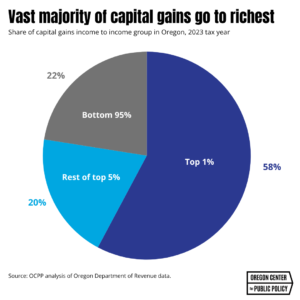
Capital gains, the profits from the sale of an asset like business stocks, flow very heavily to the top of the income distribution. In the 2023 tax year, the most recent data available, about 58 percent of capital gains income in Oregon went to the top 1 percent.[1] The rest of the top 5 percent captured about 20 percent, with the bottom 95 percent sharing only 22 percent.
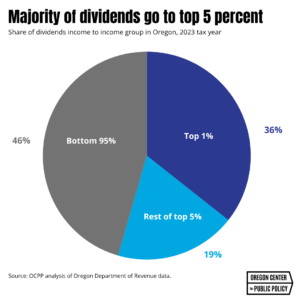
While dividends and interest income are not quite as disproportionately distributed, they are still heavily skewed towards the top earners. For dividend income, income earned when a stock or investment provides income to an owner without needing to sell the asset, the top 1 percent captured 36 percent, the rest of the top 5 percent another 19 percent, and the bottom 95 percent received about 46 percent.
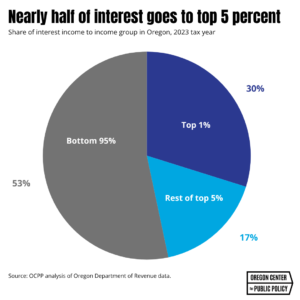
For interest income, income earned from lending money to a bank or other entity, the top 1 percent received 30 percent, the rest of the top 5 percent another 17 percent, and the bottom 95 percent got about 53 percent.
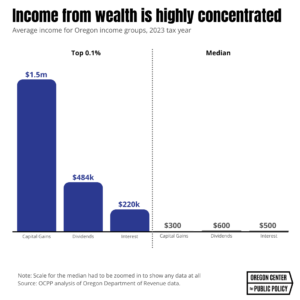
When compared dollar-for-dollar, the average member of the top 0.1 percent earned $1.5 million from capital gains, $484,000 from dividends, and $220,000 from interest in 2023. An approximation of the median Oregonian reported about $300 in capital gains, $600 in dividends, and $500 in interest income in 2023.[2]
Massive wealth disparities reflect a fundamental feature of the modern economy: capital gains, dividends, and interest arise from asset ownership, and assets are overwhelmingly concentrated among the wealthy.
These disparities reflect a fundamental feature of the modern economy: capital gains, dividends, and interest arise from asset ownership, and assets are overwhelmingly concentrated among the wealthy. The role of capital gains income fueling income inequality is not a new phenomenon. A 2013 study, for example, compared the impact on inequality levels from changes in wage income, capital income (including dividends), and taxes from 1991 to 2006. Capital income was “by far, the largest contributor to this increase,” the report concluded.
Oregon Has an Answer: The Wealth Proceeds Tax
Given the harmful effects of runaway inequality, public policy has a clear role in mitigating the damage. Capital gains, dividends, and interest income widen the gap between working families and wealthy asset owners who extract value from the labor of Oregonians. Oregon can push back against this driver of inequality by enacting a Wealth Proceeds Tax.
The Wealth Proceeds Tax is modeled on an existing federal tax on investment income above $200,000 for single filers ($250,000 for joint filers). It would apply to the same categories driving the inequality documented here — capital gains, dividends, and interest — as well as other forms of income derived from owning assets: rental income, royalties, and passive business income. It would not touch wages, retirement account income, or income from actively managed small businesses.
Only about 4 percent of Oregonians currently pay the federal tax that the Wealth Proceeds Tax is based on, and more than 60 percent of those earn over $1 million per year. Roughly 96 percent of Oregonians would not pay the Oregon Wealth Proceeds Tax at all.
In sum, a Wealth Proceeds Tax is a smart way for Oregon to push back against wealth inequality and its damaging effects.
—
[1] Data on state capital gains, interest, and dividend income included here was analysed by OCPP and originally provided by the Oregon Department of Revenue for the 2023 tax year.
[2] The median was calculated with Oregon Department of Revenue data averaging the income of Oregonians who make between $50,000 and $60,000 in the 2023 tax year. This is approximately the point where 50 percent of Oregon tax returns are above and below. The actual median won’t exactly match this figure. This analysis is intended to present a ballpark number, not a precise figure.