What does it mean when you have a good job, work full time, and still can’t afford to make ends meet? In this episode of Policy for the People, we meet Lora Edwards, a single mother of four who works full time as a state data analyst. Despite having a career and a steady paycheck, Lora relies on a food pantry twice a month to help feed her family. She describes the difficult choices and relentless budgeting required to make it through each month.
We learn about Oregon’s affordability crisis through the experiences of people like Lora, who are struggling to keep up with the rising cost of food, housing, and other essentials. Then, Kathy Lara of the Oregon Center for Public Policy discusses her research showing that many Oregon jobs simply don’t pay enough to support a family.
Listen to prior episodes of the show.
Follow Policy for the People on your favorite podcast app!



Transcript
[We make this transcript available for your convenience and to increase the accessibility of our content. The transcript was generated by software and was slightly edited for clarity. If you are able to, we encourage you to listen to the recording.]
Jeslyn: If you’re feeling broke, you’re not alone. The sad reality is that many families in Oregon and across the nation are struggling financially. Today its very clear that the rising cost of gasoline, food, childcare and other essentials is rising, putting pressure on family finances. But there are two sides to the affordability crisis we’re living under. One side is what we see when we go to the grocery store or gas station, the seemingly relentless increase in the price of everyday essentials. The other side of the affordability crisis is that of wages. Simply put, too often wages are not enough to support a family. This leaves many hard working families in Oregon under severe financial strain, as they struggle to make it from one paycheck to the next.
In this episode of Policy for the People, we explore the affordability crisis as experienced by Oregonians.
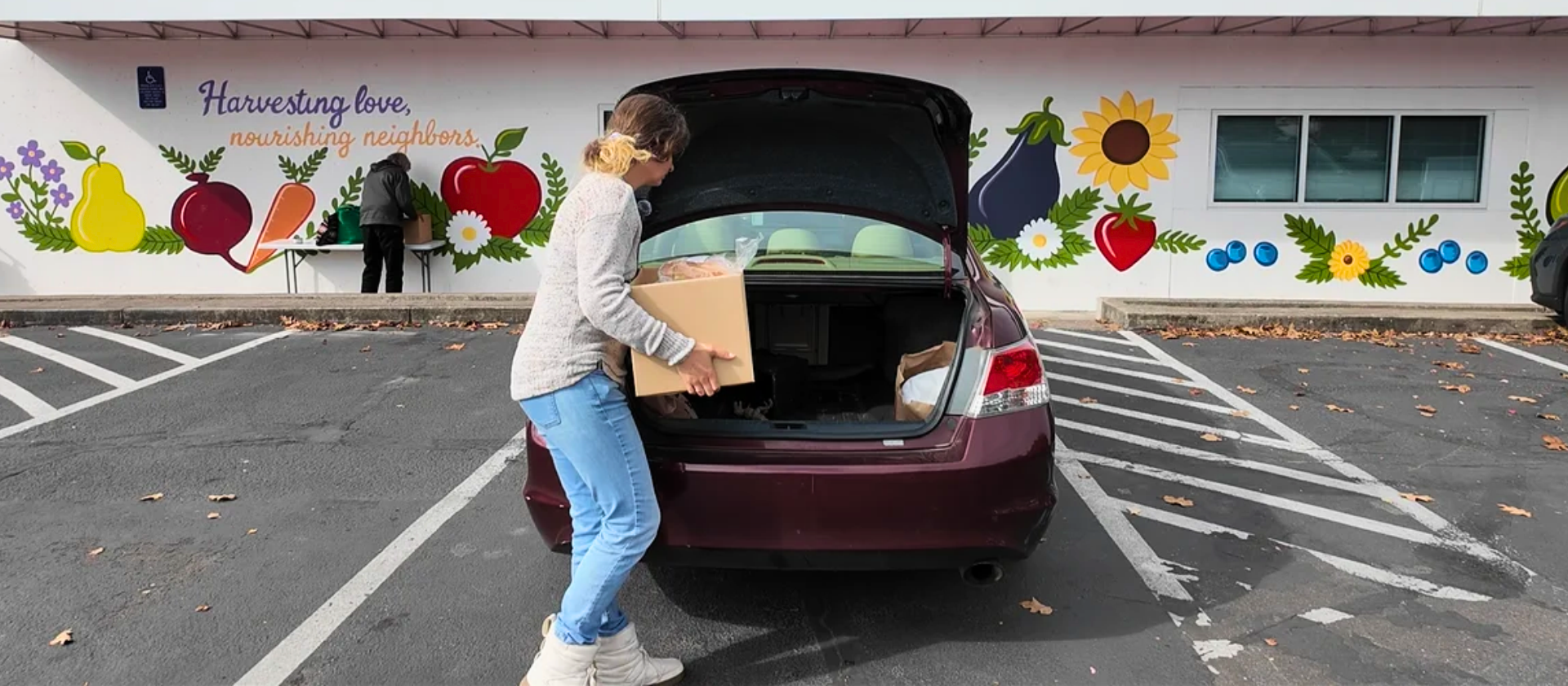
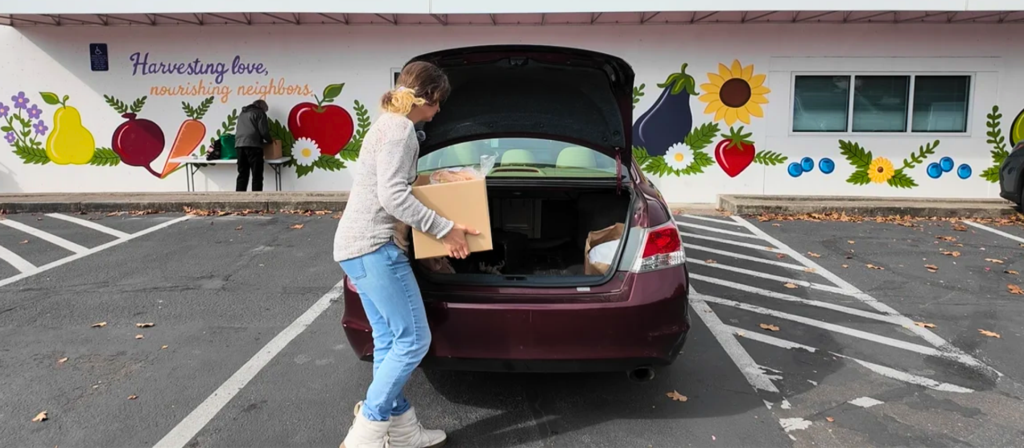
We begin in the parking lot of a food pantry in Eugene, where we meet Lora Edwards.
Despite having what she describes as a good job and career, Lora finds it necessary to go to the food pantry twice a month to help feed your family. Lora’s pay doesn’t stretch far enough to make ends meet. She shares with us the story of her struggles, of her perseverance in keeping her family afloat, and her wish to see lawmakers in Salem enact structural changes that could make a real difference for the many families who are in a similar situation.
The reality is that many families in our state are struggling to make ends meet. In the second half of our program, we hear from Kathy Lara, a policy analyst with the Oregon Center for Public Policy, who recently wrote a paper titled “Many Jobs Pay Too Little to Support a Family.”
Kathy explains that the median wage, the typical wage, is rarely enough to cover the bare minimum of the cost of raising a family, much less enough to ensure a truly stable financial situation for families. Stay tuned.
Lora is a quiet, unassuming woman with long hair and a shy smile. I met Lora at a food pantry in Eugene run by Catholic Community Services. She arrived in her red car. One of the car headlights is smashed and the bumper is crooked. As Lora explains, she’s been too broke for the past 12 months to get the headlight fixed.
Lora: I’m here because we’re just not quite making ends meet at home. I’m raising four boys. It’s just me, so I have a good job. But it’s not quite enough to buy all the groceries it takes to get through the month. My mortgage is half of my income, so the cost of living keeps outpacing my income. I have an actual career and it’s not enough.
Jeslyn: I’m sorry.
Like many Oregonians, Lora is struggling right now to make ends meet despite working hard to take care of her family. She works full time as a data analyst for the state. She’s been working there for 13 years, earning what would seem to be a good wage. And yet those dollars don’t stretch far enough to make it through the end of the month.
Lora: We come about twice a month. Pick up some food just to supplement.
I had to take time off work to come to the food bank because it’s only open 8 to 12 on weekdays. That’s when I work.
Jeslyn: As Lora explains, her family does not qualify for the Supplemental Nutrition Assistance Program, SNAP, what used to be called food stamps. She makes too much money to qualify for SNAP, and yet putting food on the table is still a struggle.
Lora: We’ve been food insecure off and on, but the last five years, I’d say, has been the most consistently food insecure for us.
Jeslyn: What’s your food situation at home right now?
Lora: I’m feeding, you know, four gigantic teenage boys, so they eat a lot. It’s pretty empty at home, but they give you fresh produce and meat and grains.
And as long as you can be creative with throwing random ingredients together plus soup and casserole. So, we make it work, and then, you know, we have a little bit enough to go to the grocery store for the things that the food bank can’t give you a cooking oil and staples.
After I pay my bills at the end of the month, we have like 700 bucks for all the rest of the expenses, like gas and food and really just gas and food. We don’t spend money on anything else. We get hand-me-down clothes and, Grandma buys a lot of clothes for the kids. So I’ve had a second job for three years, just doing, like, minimum wage, customer service stuff on the side, part time in the middle of the night.
I did stocking shelves at Fred Meyer in the middle of the night. I did a paper route.
It’s exhausting. I love my kids and I love my life. I wish it wasn’t so expensive to live.
I bought a house in 2020. And when I bought the house, it was like 36% of my income to do mortgage and bills, and all of that was affordable. Now I don’t know. Everything went up, EWEB (the utility bill) went up, the groceries went up.
So this place is kind of just a way to get to the end of the month.
Jeslyn: Getting through to the end of the month requires a lot of stress inducing work and planning.
Lora: Pretty sure what we’re going to get when we come. So I can plan around, like the groceries that I actually spend money on versus the groceries that they’re going to give me here. This is a lot of planning that goes into it, like to make sure that I don’t accidentally spend money on something that should be free.
We notice the smallest things. I know exactly how much to the penny in the milk gallon of milk costs? I can get a gallon of milk. Whole milk. I got to buy whole milk because I hae eating disorder kids for $3.89. But when it went up to $4.04, I was scrambling for pennies. Like, it’s not not a small thing for it to go up $0.25 for us.
Like, that ruins the plan. And then bread, just the staples. Staple items, even my white vinegar and flour have gone up. I try to make food from scratch because it genuinely is cheaper to make food from produce and dry goods. It is, but, you know, I’m, I’m working 40 hours a week and making food from scratch, like, I’m baking all the time just to get snacks on the counter.
My stamina is, I’m going to burn out. I feel like I should not need this at all. I have a career. I have done all the right things and it’s not. It’s never been this bad for us. Now I don’t even think about buying clothes or unnecessary things like buying a freaking bank of toothbrushes is a whole consideration at this point. Like, I could do that, but I need bananas. So there’s entire aisles of the grocery store that I do not go down. I don’t. I go produce to the dairy, to the dry goods, to the bread.
That’s it. If I walk down any of those aisles with the processed foods, I’m immediately reminded I’m freaking broke.
Jeslyn: As Lora sees it, her predicament and that of others in her situation boils down to a system that just no longer works for ordinary folks.
Lora: Every time I hear rumor of a wage increase or any kind of anything, I’m calculating and I’m counting months and I’m trying to figure out, is this cost of living adjustment going to ease up for us, the burden that we’re dealing with at this moment.
This is a systems issue, right? And so the solution has to be system based. And right now the system serves the people at the top. And I know that sounds super cringey, but the people raising the prices for us are still making good money. As shareholders, as company owners, as businessmen. They’re doing just fine. They’re passing down these increased costs to us and stressing out the systems that fill in the gaps.
And for what? Like, I understand that labor costs are part of doing business, and they’re supposed to keep labor costs down. But if you don’t pay people, and then when you do have to pay people more, you pass on the cost to the people purchasing your goods and services. You’re stressing out the public and social systems because that’s where it’s going to go.
They’re going to have to take a hit at the top in order to level out the system and fix the process. And this isn’t a “we all need to tighten our belts-situation.” This is a “you guys are messing with the system” in such a way that the pendulum has swung too far and we’re all in survival mode.
And it’s not because they’re not making money at the top. It is because they’re making money at the top and they’re passing on the cost to us. I’ll fight. I’ll fight to keep my house. I’ll fight to keep my kids, but I just. Why are we fighting? Why is it so hard?
We live in a developed country with privilege. I don’t know how people are supposed to grow and thrive in an environment where you’re surviving. If you want us to do better. Fix the system so we have the bandwidth to improve.
Jeslyn: That was Lora Edwards, a single mom sharing her story of her struggles making ends meet in Eugene, Oregon, despite having a good job and career as a data analyst. If you’re just tuning in. You’re listening to Policy for the People. In the second part of our show, we go more deeply into the affordability crisis from the perspective of wages, from the fact that many jobs don’t pay enough.
My colleague, Juan Carlos Ordonez, spoke with Kathy Lara, policy analyst with the Center for Public Policy, about her recent paper showing the extent to which jobs don’t pay enough in Oregon to support a family. Here is their conversation.
Juan Carlos: Hi, Kathy. How are you? So, Kathy, you recently wrote a paper titled many Jobs pay too little to support a family. What would you say is the main takeaway of this report?
Kathy: You know, the big picture of this report is that many families are struggling to meet their basic needs.And the reason for this is that a lot of jobs aren’t paying the necessary wages for these families to meet their basic needs. And so the problem of this affordability crisis, the cost of living, is deeply connected to the fact that many jobs aren’t paying enough for families to meet the cost of living
Juan Carlos: Kathy, I want to ask you about the details of your report. But before we get too far into the details, I just want to define a term that comes up a lot in your paper, which is the median wage. What is the median wage?
Kathy: Yeah, absolutely. So the median wage is just the wage that’s in the middle. So if we were to line up all the jobs in Oregon from lowest paid to highest paid, then the median would just be that middle wage of jobs are paying.
So that middle, middle figure. And so all the jobs and then half of the jobs below that would be below that medium wage. And the other half of the jobs would be above that median wage. Yeah. So the job right in the middle, kind of a very typical kind of wage.
Juan Carlos: And how much is the median wage in Oregon, by the way, in 2024?
Kathy: The median wage in Oregon was $25.54.
Juan Carlos: So what specifically did your research find when you analyzed the wages here in Oregon?
Kathy: Yes. So when we looked at the data, the figures, the budgets, we saw that the median wage was not enough for many families, especially families with children, to meet their basic needs. Right. So when we looked at various budgets for different types of families or household types, we can see what was the budget needed for these families just to make ends meet.
Right. Just to survive in our communities. And so when we looked at, when I looked at these different households types or these different families, I saw that the wage needed for these families was above the medium wage. Right. So for these families just to survive again, they would need a higher wage than the median then the current median wage.
What I did is I looked at the survival budget developed by the United Way. The United Way has developed something called the survival budget, where they break down the budgets necessary for different families, different family types. For example, an adult would be one family to two adults. Two children would be another family type. They broke down these different types of families and saw what was the wage necessary for these types of families to survive.
When you take into consideration things like transportation, food, gas, rent, health care. They took that into their consideration. What it takes to survive. Knowing that to survive, we need all of these things. What’s the bare minimum, t That’s the survival budget. And they did that and they broke it down to four different types of families.
So for example, when we’re looking at families, especially families with children, what they need to survive the bare bones right in our communities is way above the median wage. And it’s really only enough. The median wage is barely enough for families that are, you know, one parent, one child or a single adult. The medium wage is barely enough to cover basic expenses.
Right. And so again, we’re talking about very basic expenses from the from these families just to survive. For example, if you look at, you know, the family type that is one, one very young child because of the high cost of child care, that household is going to need something higher than a median wage, and they’re going to need about $27 an hour just for this, this family type to make ends meet.
So that’s one example where, you know, families with children need more than the median wage just to survive.
Juan Carlos: We’ve been talking about the median wage in Oregon, and how that is usually not enough to support a family with kids. But as you explained at the beginning, half of all jobs pay less than the median. Can you talk to us about what you found regarding jobs that pay less than the median?
Kathy: Yeah, I mean, so when I looked at the data, when I looked when I started to break down what jobs are actually paying, I found like a good portion, a significant portion of jobs are paying less than $20. 30% of all jobs are paying less than $20 an hour. And so when we take what families with children need to survive, that’s not enough for any families with children to survive, to meet their basic needs.
Juan Carlos: What kind of jobs are we talking about here? When we’re talking about jobs that pay less than $20 an hour? Are they concentrated in particular industries, in particular areas? What do we know about those jobs?
Kathy: Yeah, I think it’s really important to take into consideration that these lower paying jobs, they’re not concentrated or they’re not found in all industries equally. They’re really concentrated in certain sectors. If you look into the retail industry and the leisure and hospitality industry, these two industries just together, just these two industries together make about 43% of all the jobs paying less than $20, $20 an hour. So a big bulk of them can be found in these two industries. And by the way, what I mean, leisure and hospitality, I mean places like bars, restaurants, hotels, places that give you accommodations for the night.
That’s leisure and hospitality. But they’re also concentrated in other important industries like health care. And a small percentage, a smaller percentage is also found in natural resources, which includes mining, but it also includes agriculture. Right. So industries that we depend on to survive are also found to have lower paying jobs.
Juan Carlos: So Kathy, in an earlier area in this country, it was pretty typical that a family could survive on just one wage with just one paycheck.
But as your research shows, that’s definitely no longer the case. What has happened that has gotten us to this situation where families cannot make a living with one paycheck. What are the dynamics behind the situation?
Kathy: I think one of the most important dynamics happening at play currently is the loss of power that workers are facing in the workplace.
The situation that you just described back in the day, that was the heyday of strong union, strong union membership where workers had a bigger voice in the workplace. So they had a bigger voice in the economy. So they were able to capture more of that gain from that growth than they are today. I mean, it used to be that the height of unionization was around 30% in the 1950s.
And so workers had real power, real bargaining power to make sure that they were getting a decent wage and adequate benefits to survive. But that’s not the case anymore. Right. There’s been a slow, a slow, but steady decline in worker voice in unison. The result of that is what we see today were workers, you know, lack of voice or the fact that wages have not kept up with the cost of living.
And when we look at Oregon specifically, I mean, we’ve been at around 15% unionization rate for the last decade or so, I think even more so, you know, and that’s, that’s different from the head, the heyday in Oregon’s higher union membership. Right. And things are even worse at the national level. Right. At the national level, I believe a union, the rate stands at around a 9.9 percent or 10 percent.
And so, you know, these figures just show the decrease in worker power and worker voice in the workplace. I think to add to this idea of declining union power, we also have to take into consideration when unions are strong, when worker voice is strong, that has ripple effects throughout the economy, right. And so when union power declines, worker voice declines.
That also means that there are ramifications in the larger economy. So when there is a strong worker voice in the industry that tends to spill over to other workplaces, right, to make sure that other businesses compete with those union wages. But when that union density is declining, that means those businesses don’t necessarily compete with those union wages.
And so that tends to spill over in other aspects of our lives.
Juan Carlos: Given all this, what needs to happen to turn things around? What kind of policy changes do we need?
Kathy: We need a wide array of policies, right. It has to connect to increasing worker power, to boosting incomes, to making sure we offset the cost of basic needs. Right. So when it comes to worker power, we have to make sure that all workers have the right to have a voice in the workplace. There are workers today that don’t have the same right to organize and negotiate with their employers. Compared to other workers. And that means farm workers, domestic workers, Uber drivers, don’t have traditionally these rights that other workers have had since the 1930s.
And it’s really important to make sure that these workers have those rights well as well. Another thing is we have to make sure we implement workforce standard boards. These boards are just public bodies, public boards that are made of employers. Workers, the public for a certain industry. And these boards are in charge of setting minimum industry standards.
And when you do that, when you are allowed to set minimum standards, you get to raise the working conditions of many workers at a time because you’re doing it industry by industry. I think it’s also important to consider boosting income, right, to making sure working families and very low income families get to meet their basic needs. And so that means strengthening the minimum wage and making sure what the minimum wage allows people to meet their basic needs.
We have to make sure we have unconditional cash support to allow working families to meet their basic needs. It also means strengthening, you know, our current tax programs like the Oregon Kids Credit, the Earned Income credit, so that moderate and low income families are also able to get their basic needs met. And another, you know, a set of policies we have to implement is to make sure that we offset the cost of basic goods for families.
One thing we have to consider is investing in a robust child care system. I think right now childcare is a very prominent issue for many families. Many families are priced out or cannot afford basic childcare. And so we want to make sure that if families have accessible childcare, we have to make sure we’re investing in this infrastructure for them.
We have to make sure we’re investing in health care for all Oregonians so that it’s a fair and accessible, affordable and accessible for all Oregonians.
Juan Carlos: For the listeners who may be wondering what can they do to help improve things here in our state, are there ways that you would suggest that the listeners can get engaged?
Kathy: Yeah, I think listeners can do what workers have always done for a very long time, and that is get together with their coworkers and form a union and negotiate for better working conditions.
It’s something that allows for people in their lives to have a say in the trajectory of their lives. Getting together with your coworkers to be recognized in a union means that you get to exercise collective power over your wages, over your working conditions.
Juan Carlos: So, Kathy, any final thoughts you want to share with us regarding this idea, this finding that too many jobs pay too little to support a family?
Kathy: Final thoughts I want to say that right now there are many Oregonians that are working very hard, and many of these same Oregonians that are working very hard are still not making ends meet. If we want Oregon to be a place for families to thrive, if we want to be a place that families see the state as a place to have and raise their children, then we have to make sure that we’re investing in the infrastructure to make that happen.
So that means strengthening the minimum wage so workers can meet their basic needs. And that means strengthening workers rights in the workplace so that workers are able to collectively come together and bargain, to have the wages and benefits that they need, not only to meet their basic needs, but to thrive as well. Well, Kathy, thank you so much.
Kathy: Thank you.