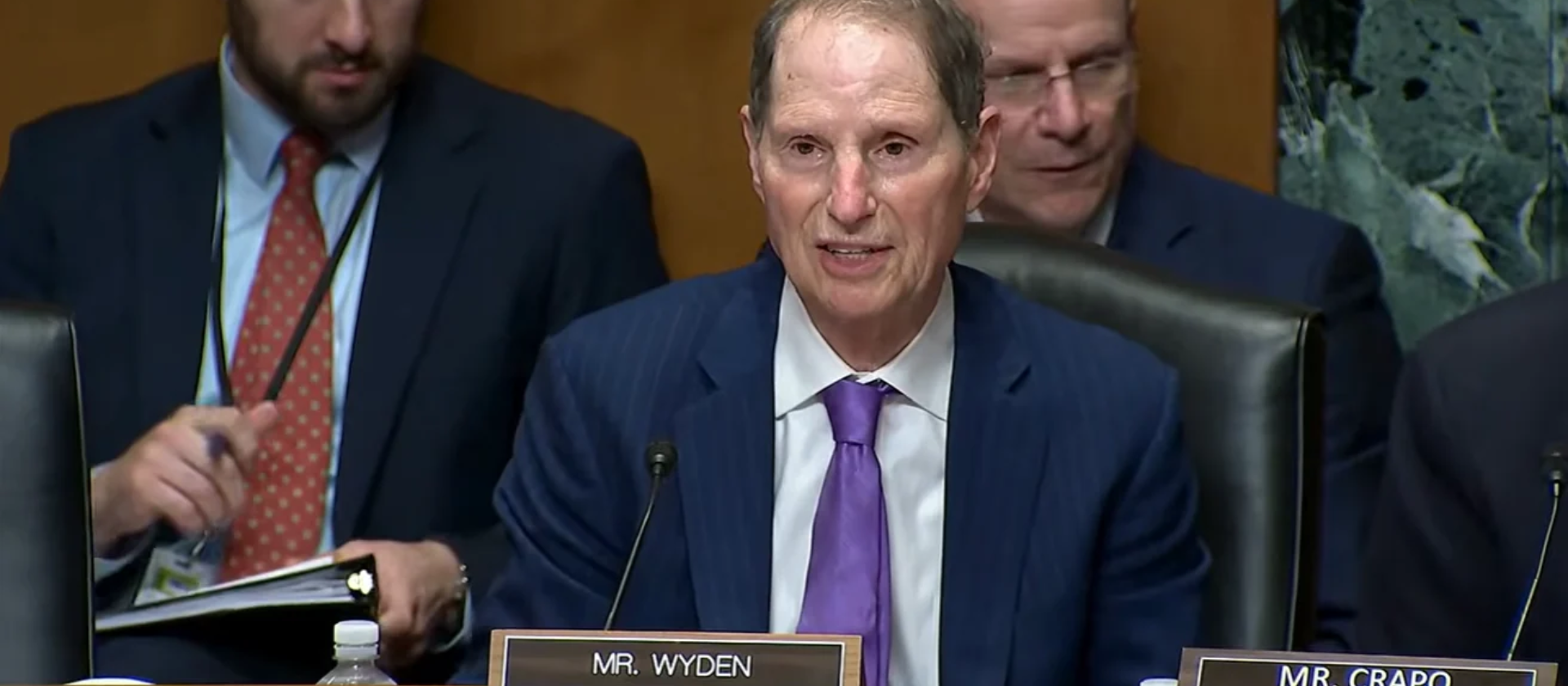
Oregon Senator Ron Wyden is in line to become chair of the powerful Senate Finance Committee, which oversees our nation’s tax policy. In this episode of policy for the People, we play a conversation with Senator Wyden recorded just days prior to the midterm elections. We discussed the changes he thinks need to happen to make the federal tax code work better for working people.
In the second half of this episode, we continue our focus on tax policy, this time at the state level. With Oregon’s budget under serious pressure in the years to come, state lawmakers need to find resources to prevent cuts to essential services like education and health care. As Daniel Hauser of the Oregon Center for Public Policy explains, Oregon can find significant sums of revenue not by raising anyone’s taxes, but simply by doing a better job collecting taxes already owed.
Listen to prior episodes of the show.
Follow Policy for the People on your favorite podcast app!



Transcript
[We make this transcript available for your convenience and to increase the accessibility of our content. The transcript was generated by software and was slightly edited for clarity. If you are able to, we encourage you to listen to the recording.]
Juan Carlos Ordonez (host): Although votes are still being counted in what will surely be considered a historic election, it’s clear now that the 2026 midterm elections have shifted control of both chambers of Congress to the Democrats.
That means that come January, there will be new chairs of congressional committees. This includes the powerful Senate Finance Committee, which, among other things, oversees federal tax policy. And the person likely to take the gavel of that committee, to become chair of the Senate Finance Committee, is Oregon’s senior senator, Ron Wyden, who has previously served in that role.
In this episode of policy for the People, we play a conversation with Senator Wyden recorded just days prior to the midterm elections. In that conversation, we discussed the changes he thinks need to happen to make the federal tax code work better for working people.
In the second half of this episode, we continue our focus on tax policy, this time at the state level. With Oregon’s budget under serious pressure in the years to come, due in large part to cuts to health care, and nutrition assistance enacted by the Trump administration last year, state lawmakers will need to figure out a way to find resources to prevent cuts to essential services that all Oregonians count on. As it turns out, Oregon can find significant sums of revenue not by raising anyone’s taxes, but simply by doing a better job collecting taxes already owed. My colleague from the Oregon Center for Public Policy, Daniel Hauser, discusses why, as a matter of fairness and common sense, Oregon lawmakers should prioritize closing the tax gap.
Stay tuned.
Juan Carlos: Senator Wyden, welcome to Policy for the People.
Senator Wyden: Thanks for having me back.
Juan Carlos: We invited you today to come and talk on the show about some of the specific pieces of tax legislation that you have introduced recently. But before we get to those, I wanted to start by looking at the big picture. How would you describe the current state of our federal tax system? How well is it working for regular folks?
Senator Wyden: It’s working great for the billionaires and not so great for the people that you’re talking about. And I feel very strongly that my job is the senior guy on the finance committee, is I want a tax system that gives everybody in America the chance to get ahead. And today, I hope we’ll have a chance to blow the whistle on the wealthy tax cheats, because they’re doing things that can hold people back.
Juan Carlos: You mentioned the billionaires. Just to follow up, to what extent would you say tax policy has helped create the extreme levels of economic inequality that we see today?
Senator Wyden: I think it’s been a huge factor. And remember that at the big Trump kickoff when he was being sworn in, the people behind him were the billionaires. And basically he was sending a message. Those are the people he counts on.
Juan Carlos: You recently introduced legislation called the Billionaires Income Tax Act. What would this legislation do and why is it needed?
Senator Wyden: It’s needed because it’s time for the billionaires to pay taxes just like everybody else. For example, right now there’s something called Buy, Borrow and Die. And if you use that as a billionaire, you can get away with paying virtually no taxes for the bulk of your life.
You just call up your accountant. You say, make sure I don’t take any income this year. I can live off my borrowings. And you can use Buy, Borrow and Die, and then your kids can use it. Let me give you an example. Under Buy, Borrow and Die, if you’re very wealthy, you could buy a bunch of buildings and you could just live off the money that you made with that, because it just sat there, just plain old sat there.
Then you can borrow against it, which is money you can use to buy your yachts and the like. And you don’t have to do anything until you die. That’s it.
Juan Carlos: Some might say that taxing unrealized capital gains is not the same as taxing income. How would you respond to that?
Senator Wyden: I would respond by saying that what we need to have is a tax system where everybody pays taxes every year, and that is the way it works for the working person.
If you’re a nurse or a firefighter or a teacher, you pay taxes with every paycheck. If you’re a billionaire, you shouldn’t. And that’s what I’m going to change with my bill. And I’ve got 25 United States senators currently sponsoring it.
Juan Carlos: How would you say this proposal, the billionaire income tax idea is going over with your colleagues in Congress. What are they saying in response to this proposal?
Senator Wyden: The 25 United States senators who signed on as co-sponsors didn’t do it by osmosis. We spent a lot of time talking about it, because most people didn’t know, for example, that these billionaires could evade taxes in a very specific way, which I just described. That’s why I think we’re well positioned.
Obviously, we’ve got to get some Republicans, but I think it becomes almost indefensible given the growing inequality that you mentioned, to basically say we can have a system where, (by the way, this was printed in the Wall Street Journal, Juan Carlos, this was not in some, you know, left wing publication) It was in the Wall Street Journal. That’s where I heard about it for the first time.
Juan Carlos: Another big topic when it comes to taxation is corporate taxes. What’s your assessment of how well our federal taxes are doing when it comes to taxing corporations fairly and effectively?
Senator Wyden: That too is coming up short. Recently, we got a report indicating that corporate taxes went down. But what’s going on is a lot of the big corporations are claiming the research and development tax credit when they’re really talking about their big growing businesses.
Juan Carlos: Yeah. In fact, there was a story in the headlines recently that Meta, the company that owns Facebook and Instagram, has been massively shrinking its tax bill using this R&D tax credit.
Senator Wyden: That was the one that I described to you. And we were the ones who initiated that with the press so that people would know yet another way that meta and these big companies are gaming the system, and we’re going to close that loophole as well.
Juan Carlos: What needs to happen to close that loophole? What would be the steps to get there?
Senator Wyden: What you have to do is write very carefully. You know, you go in with a scalpel, really, and make it clear that you can’t use the R&D tax code for the kinds of things that you traditionally use, the investment rules.
Juan Carlos: Another issue when it comes to multinational corporations is offshore tax avoidance. So that’s when a corporation artificially shifts profits earned here in the U.S. and even in Oregon, to a jurisdiction that levies little or no corporate income tax. How big a problem is offshore corporate tax avoidance, in your view, and what needs to happen to put an end to it?
Senator Wyden: It’s a big problem, and it’s particularly serious with respect to pharmaceuticals. In effect, what you have is somebody selling a pharmaceutical in Oregon or West Linn or any part of our state, and basically making sure that they’re taking the tax break overseas. And we’re going to close that loophole as well.
Juan Carlos: Early on during the first Trump administration, there were provisions in that massive tax package passed in 2017 to try to close off some of these loopholes, at least that was the rhetoric behind it. That doesn’t seem to have worked. Would you agree?
Senator Wyden: Well, you captured Juan Carlos, you captured the key phrase. It was rhetoric, and it was set up to make people think they were doing things. But if you really strip it out, there’s not much there. A rich tax cheat who is sheltering the mountains of cash among a web of Shell companies and pastors, has a better chance of being struck by lightning than to face an IRS audit, and that’s why they can get away with it, just as your question suggests.
Juan Carlos: And this is a good segue to talk about another important topic, which is funding for the IRS. Earlier this year, you introduced legislation to restore funding to and strengthen the Internal Revenue Service. How would you describe the state of the IRS over the past few years and perhaps decades.
Senator Wyden: Under the Trump administration, they’ve been clobbered. They’ve had one person after another go into the IRS and they don’t stay long.
And my bill to Stop the Cheaters Act would restore and revitalize the IRS with additional funding for enforcement against evasion by the high fliers. There’d be money for technology operations, support, systems modernization and taxpayer services that are so important for working families. So we’ve got a big collection of sponsors on that. I hope we’ll be able to use that.
And Buy Borrow and Die, central approaches early on, getting rid of Buy Borrow and Die.
Juan Carlos: One of the very unfortunate things that we saw over the past year and a half, when the Trump administration came into office, was that they pulled the plug on Direct File, which is was a free and public platform for people to file their taxes so that they wouldn’t have to pay companies like Intuit to in order to file their taxes.
What are the prospects of reviving Direct File? Are there efforts to bring it back?
Senator Wyden: Yes, and I’m leading them. Right now, Juan Carlos, we are the only Western industrialized nation, the only one who doesn’t make it possible for people to file their taxes in this way that you described. That doesn’t involve red tape and bureaucracy. It’s outrageous that we’re the only one who stands out.
It’s only because of the tax prep firms that spend millions of dollars lobbying the Congress. But we’re going to get it done when we’re in the majority.
Juan Carlos: Senator, I’m wondering if there are any other pieces of legislation or issues involving our federal tax system that we haven’t covered that you’d want to discuss with our audience?
Senator Wyden: Well, we’re also concerned about the data centers, because these big corporations and the costs they impose on people for extra expenses for water and power and consumption, and the way they do it is they use the tax code.
So we’ll be having more to say about that down the road. We got the square keepers at Joint Committee on Taxation, scoring it. I’ll have more to say about it. But stay tuned because these data centers are ripping Oregonians off in a number of particulars. In fact, I think I’d say, is these data centers are built and owned by some of the biggest and wealthiest tech companies, and they ought to be taxed to return some of their profits to the communities that they profit off of.
And I’m going to do that.
Juan Carlos: Yes, and there was a big story in The New York Times again recently on Meta taking those, as we discussed before, the big R&D tax credit for, it was specifically for AI data center build out. Right?
Senator Wyden: No question about it. Yes. That’s where the cash is to be made. These companies are huge and they can basically come in, they have lobbyists, they have money, they have connections. They come on and they stomp all over everybody. And by the time you’re done, they have water problems, power problems, all kinds of environmental problems. And that’s what we’ve got to rein in.
Juan Carlos: Senator Wyden, as we wrap up, I’m wondering if you have any final thoughts that you want to share with us about the state of our federal tax system and how we can make it work better for the people of this country.
Senator Wyden: The way we can make it work better is we can be very explicit in saying we want a tax system that gives everybody in America the chance to get ahead. You know, people always ask me, well, Ron, aren’t you for people being successful? Hell yes. I just want everybody to have a chance to be successful and everybody to get a fair shot.
That’s America at its best. And that’s what my tax reforms will be all about. And we just went through a number of them. And that’s what our focus will be.
Juan Carlos: Well, Senator Wyden, thank you so much.
Senator Wyden: Thanks a lot, Juan Carlos, take it easy.
Juan Carlos: If you’re just joining us, that was Oregon Senator Ron Wyden discussing his priorities when it comes to federal tax policy.
Senator Wyden is in line to become the next chair of the U.S. Senate Finance Committee, which oversees the nation’s tax policy. Tax policy will also be a big topic of discussion at the state level when the Oregon Legislature begins to meet in January. How to protect funding for essential services like education and health care will be in the minds of lawmakers as the state stares at long term budget shortfalls.
These fiscal difficulties are due in large part to the Trump administration’s cuts to funding for health care and nutrition assistance, enacted last year as part of H.R. 1. The so-called One Big, Beautiful Bill. So where can Oregon find the money to prevent cuts to essential services? One common sense place to look is to the people and corporations who are currently not paying the taxes that they owe.
My colleague from the Oregon Center for Public Policy, Daniel Hauser, recently wrote a paper titled, Closing the Tax Gap, Making it Easier to File and Harder to Cheat. I asked Daniel to explain the issue. Here is our conversation.
So, Daniel, you wrote a recent report that says that Oregon can raise large sums of revenue to fund schools and other essential services without raising anyone’s taxes. Can you explain what you mean by that?
Daniel: Our research found that Oregonians, you know, disproportionately very rich Oregonians, are avoiding paying what their fair share would be. And they’re doing this in myriad ways.
But fundamentally, we’re talking about folks who aren’t paying the taxes that they otherwise should owe the state. You and me, we pay our taxes, I hope. I don’t know if you pay your taxes. I’m going to assume you pay your taxes.
Juan Carlos: I do, I do.
Daniel: Good, good. And you know, when we get our paychecks, it shows very clearly. Right. The taxes that we contribute for state withholding, federal withholding, Social Security, all those sorts of things. But there are people, and our research found that there are a lot of people with a lot of income who are not paying their fair share. And the services that our families depend on that their families are using suffer from it.
Juan Carlos: So how much money are we talking about? How much money is going uncollected by the state?
Daniel: I mean, we think it’s confidently well over $1 billion a year. You know, the federal tax gap has been estimated a bit more precisely and is well over $600 billion a year. And this is looking just largely at the personal income and corporate income taxes.
Many other tax programs, like the estate tax or the corporate activities tax could also have really significant tax gaps as well. So that’s kind of like the big picture of the tax gap. And just for your listeners to know, the tax gap, in the simplest terms, is the difference between the taxes that are actually owed and the taxes that are paid.
Right. And so what we really see, you know, is that this tax gap is significant, it’s billions of dollars here in Oregon, when you look at all of the programs over a period of time. And, you know, there is a huge share of that that the state can be collecting that we could be bringing in to fund the services Oregonians depend on.
Juan Carlos: What’s behind this tax gap? Why is it that Oregon is leaving money on the table?
Daniel: One way of thinking about this is that there are all different types of income, right? There’s wage income like I talked about, you and I earn where the IRS gets the Department of Revenue gets very clear reporting from the business, right? How much they paid us and how much taxes they withheld.
So they have independent reporting. They have an idea, right? Regardless of what we put down on our taxes. With wage income, the tax gap is very small, right. Because of that independent reporting and there’s independent reporting with certain other types of retirement income and other programs too. But it sort of depends. And then there’s a whole other sort of subset of income that is, you know, income from certain types of business income or investments.
You know, you don’t necessarily always tell the IRS how much profit you made when you’re selling, you know, part of your art collection and things like that. Right. So there’s a whole subset of income that has much, much higher levels of the tax gap, right? Where basically of that income, a much smaller share of it is being properly reported and properly paid to the Department of Revenue.
And so that’s really what drives an interesting finding in our research, which is that the tax gap is disproportionately sitting with individuals and corporations that are very well off. Right. We’re talking about very rich people, very profitable corporations is really where we see the preponderance of the tax gap.
Juan Carlos: You’re right in the paper that there are basically three categories of how should I say it? Ways in which people don’t pay their taxes. Can you talk about those three different categories that give rise to the tax gap?
Daniel: You know, it’s helpful, I think to process this with examples. So let’s say someone makes $1 million trading crypto, but they only tell the Department of Revenue they made $1,000. Right. So there’s, you know, $999,000, they’re not reporting. That’s called underreporting, right? They’re reporting less income than they should have. And that’s about three quarters of the tax gap. Right. It’s the largest share. The next largest share is called underpaying. So an example here would be someone who tells the IRS all the income they earned, but they only pay $100 when they actually owed $1000.
So the smallest group, though about 10% of the tax group is people who don’t file at all. But they should. Right. This could be someone with lots of income who is just choosing not to file because they think they can get away with it. Maybe they have some moral opposition to taxes or something, even though they’re making a ton of money.
But it could also be someone who just didn’t think they needed to file it because they didn’t make that much that year. It could be a college student who just forgot that their part time job, you know, they made enough to trigger having to file. A lot of folks just made honest errors. Right. Like we’ve created a tax system that is shockingly complex.
I mean, people trot out the Internal Revenue Code and it’s like, you know, whatever ton of weight it would be if you printed it all out as an example of government complexity. Taxes are hard, right? It’s hard to file. And, you know, I think we need to appreciate people make honest mistakes, and we shouldn’t come at them as if they were, you know, consciously trying to cheat the system and screw over their neighbors.
Right. But there’s a whole other class of folks who are actively trying to come up with ways where they can avoid paying for the public services that they are using. Right. And so this is this is the class of folks who, you know, might be hiding, wealth proceeds from some investments in their kid’s trust account or something and trying to use these illegal ways of maneuvering all the income they’re earning so that the taxing authorities, the Department of Revenue, can’t find it and can’t tax it.
Right. These are, you know, there are greedy tax cheats, right, who are taking advantage of the system. And that’s the exact purpose of auditing and enforcement collections work at the Department of Revenue.
Juan Carlos: Given all this, that there’s different ways that people are not paying what they owe and for different reasons, sometimes benign, sometimes intentionally. What should the state do?
Like what are the policy responses that we need to see the legislature take?
Daniel: Yeah, the legislature really has two kind of piles of work. I would say that they need to focus on. The first is really for the people that are trying to do the right thing. Right. They’re trying to pay their taxes. It’s just hard and complicated.
You know, we should make it easier. Functionally, we have a state system that’s only a couple years old called Direct File Oregon. That is a free, extremely user friendly system where you just answer some questions like you would in any other, you know, high quality tax software. And so these questions, you file your taxes directly with the Department of Revenue.
It’s as easy as possible. And we should invest in that program. We should make it easier. We should continue going down that path of making taxes as easy to file as free as possible for working families and small business owners. There are other people who have like really complex taxes and just a simple website won’t work.
They need help. So we should invest in a program Oregon already has called the Tax Infrastructure Grant program. This program puts money into community non-profits, into low income tax assistance centers all over the state where people can come in, they can bring in their W-2, you know, their wage statements, their income statements, things like that.
And qualified volunteer professional person will walk through their taxes with them. There’s the other side of it, though, which is the people who are actively trying to hide their income, their profits, their wealth from the Department of Revenue. And for this group, you know, the solutions really depend on the type of tax gap we’re talking about.
So earlier we talked through underreporting, right. Folks who are not reporting all the income they earn. I gave the example of someone who has $1 million crypto profit. Right. Only reporting $1,000. This is really where auditing is the type of action that is needed. Someone you know has trained and skilled at auditing goes in and looks through this person’s income, you know, reviews their account balances and things like that, and ask tough questions to make sure that they’re not cheating and hiding money.
So, you know, to address underreporting, we really need to look at auditing. If we’re looking at, for example, underpayment. Right. In this case we need collections agents. Right. We need folks who follow up. There are cases where people owe tens of thousands, hundreds of thousands, millions of dollars to the Oregon Department of Revenue and are just, you know, we know they owe it.
They know they owe it. And we need to go through the process of collecting these taxes. For the last group, the non-filers, there are new innovative ways to try and use other data sets to find people who are not filing their taxes. You know, it’s a little harder for the Department of Revenue if someone’s never filed their taxes.
In Oregon, because for the Department of Revenue, they don’t really exist, right? It’s hard to see, hard to audit, hard to find. But there are innovative ways other states have been looking at it, where you’re able to really, like, identify significant income wealth reported. And if that person’s not, you know, overlapping with the Department of Revenue, then the department’s able to go about trying to find those folks and reaching out.
You know, it might be the case they’re not supposed to file. There are lots of people who just aren’t legally required to file, but the Department of Revenue should have the resources necessary to go in and look.
Juan Carlos: What has the legislature done in recent years with regards to this issue of the tax cap? Had they taken action in one way or another?
Daniel: I think this is a situation where a lot of folks in the legislature didn’t realize the magnitude of the problem, didn’t realize the opportunity that was possible in long term revenue if they invested in auditing, tax enforcement collections. And so they’ve taken some steps that are counterproductive. In a recent budget process, they cut staff that did auditing and collections work that were revenue agents working on this issue.
And that’s the kind of step that we need to stop taking. Right. That is a very much a, you know, save a dollar today and, and, you know, lose $100 tomorrow kind of approach. And I think it’s important that the legislature reassess the importance of investing in tax auditing and enforcement. But right now, the Oregon Legislature is facing a budget deficit in the upcoming legislative session that’s going to be significant.
Now, most of what is driving that are federal cuts to programs that give people access to health care, give people access to food. And so, you know, there are challenges being thrust upon the Oregon legislature by the federal government where they’re going to have to backfill. So some services that the federal government used to pay for.
But the state’s not coming into this flush with cash, right. The state’s coming into this challenge having already cut programs in the last long session, cut programs that help people afford the rent, that help people afford child care, like we’re already coming out of tough budgets. And so having these hundreds of millions of dollars in cuts to health assistance thrust on them is really difficult.
And so that has two implications for this work around the tax cut. One is the legislature feels like they don’t have money to spend, right. They feel like every penny counts. And so there’s certainly, I think, some concern about putting money into the Department of Revenue when we have folks losing health care. But the other side of it is we need every dollar we can get.
We can’t leave hundreds of millions of dollars every year on the table in Oregon, because we’re just not enforcing our existing laws. And that’s really where I hope lawmakers will focus in this upcoming session. Let’s enforce Oregon’s tax laws by investing and auditing, investing in collections agents and tax enforcement. So that way we can really see long term growth in our revenues, not because we’re raising taxes, although we should, but because we’re enforcing the tax laws that are already on the books.
Juan Carlos: So you came up with an estimate of how much Oregon could raise by investing a little bit more into auditing collections enforcement. So what does that look like?
Daniel: Yeah, we estimate that around $54 million a year in investments in personal income tax and corporate income tax programs, investing in auditors, enforcement agents, collections agents, that kind of an investment would net right, including covering the costs, more than $270 million every year over a ten year time period.
It’s important that we think about it in this longer term, ten year window, because it’ll take time for folks to get hired, to get trained, you know, to have an auditor that can really go in to a rich person’s taxes and be able to find all of the ways they’re hiding money. It requires skill and training, right? So it’ll take a little bit of time for those to get up and running.
So we tend to think about it in this longer ten year time period. But if you look at it over that ten year time period, we’re talking about over $2.5 billion that the state could bring in revenue, collectible dollars like we could bring back if we’re just willing to invest $50 million a year upfront.
Juan Carlos: Daniel, any final thoughts you want to share with us regarding this issue of the tax gap and what needs to happen to address the problem?
Daniel: I would really just underline the fact that this is a question of fairness. This is a question of following the law, and we need to make sure that the Department of Revenue has the resources they need to go after the rich tax cheats, to go after the giant corporations abusing our tax code. And to do that they need more money and auditors.
They need more money and enforcement agents. They need more money in collections. But the state could see hundreds of millions of dollars in revenue, well in excess of that investment. If we’re willing to make the smart, long term choice for our future.
Juan Carlos: Well, Daniel, thank you so much.
Daniel: It’s always a pleasure.
Juan Carlos: And thank you for listening to Policy for the People. We will see you next time.