

Oregon can raise large sums of revenue to fund schools and other essential services without raising anyone’s taxes. Oregon can do so by closing the “tax gap” — the difference between the taxes legally owed and what is actually paid on time. By spending tens of millions to make it easier for working families and small businesses to file taxes and tracking down those who cheat, Oregon can collect hundreds of millions in revenue legally owed to the state. This is a rare policy that raises real money, makes the tax system fairer, and makes tax season easier for people already doing everything right.
The return on these investments would be many times the cost: a conservative analysis finds that Oregon could raise more than $2.7 billion in net general fund revenue over a ten-year period by addressing the tax gap in personal income and corporate excise tax collections. Additional investments in other tax programs, including the estate tax, corporate activities tax, could raise even more.
Oregon fails to collect well over $1 billion each year in taxes owed
The “tax gap” is the difference between the taxes legally owed and what is actually paid on time. It’s distinct from tax avoidance through legal loopholes — for example, when corporations artificially shift profits abroad.[1] The tax gap is money already owed under current law that isn’t paid, whether because someone didn’t pay their full tax bill (underpayment), someone didn’t report all of their income (underreporting), or someone never filed a return (nonfiling).
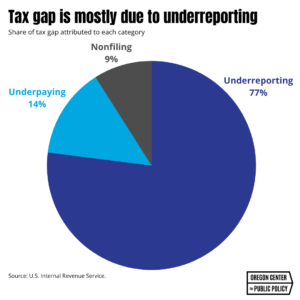
In tax year 2022, the federal tax gap was about $696 billion, about 15 percent of all taxes owed. Of that amount, about $63 billion was due to nonfiling, $539 billion from underreporting, and $94 billion from underpaying.[2] Enforcement and late payments recovered about $90 billion, leaving a $606 billion net loss in a single year.[3] Individual income taxes made up the largest share, at $514 billion, followed by employment taxes ($127 billion), corporate taxes ($50 billion), and estate taxes ($5 billion).[4]
Oregon is one of the few states that has measured its own tax gap, although the estimate is dated.[5] Using data from tax year 2010, the Oregon Department of Revenue (DOR) estimated a net gap of roughly $1.1 billion, or 17.8 percent of what was truly owed.[6] The corporate tax gap came in around 14 percent of liability, likely an undercount since it does not fully capture offshore profit-shifting.[7] Given inflation and economic growth over the past 15 years, it’s highly likely the tax gap is significantly larger now than it was then.
Connecticut, one of the few other states with a recent estimate, found a gap proportionally similar to the federal tax gap rate of 15 percent.[8] This suggests that Oregon’s own figure (17.8 percent), though 16 years old, isn’t an outlier.
Failure to pay taxes owed is more common among the rich
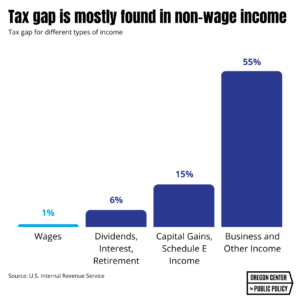
The failure to pay taxes owed is more likely to arise where income isn’t independently verified. Wage income, reported directly by employers, is rarely misreported. Only about 1 percent of wage income is misreported. Investment income reported by a third party, such as pensions, dividends, and interest, is estimated to have a tax gap of about 6 percent. Partnership and S-corporation income and capital gains rise to roughly 15 percent. Income with little to no independent reporting at all, such as sole proprietor earnings, rents, and farm income, is misreported at 55 percent.[9] It’s no accident that income from workers and retirees has smaller tax gaps than the income from ownership of businesses and assets, given that the former is independently reported.
Not everyone who fails to file a tax return or pay their full bill is cheating; the tax system is complex and ever-changing. Noncompliance runs on a spectrum, from honest filers who miss a deadline or don’t know a rule applies to them, to taxpayers whose sloppy recordkeeping causes accidental underreporting, to people who work with a team of lawyers and accountants to legally and illegally hide income.[10]
The rich account for a large share of the tax gap. A Connecticut study on the income distribution of the tax gap found that the richest 5 percent of taxpayers constituted 37 percent of the non-filing gap and 46 percent of the underpayment gap.[11] The bottom half of Connecticut tax filers accounted for less than 10 percent of those gaps.
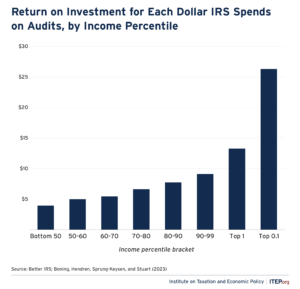
Analysis of where to focus auditing and enforcement actions mirrors this relationship: focusing tax enforcement on high-income earners yields a much higher return on investment than low-income families.[12] While audits have a positive return on investment at most income levels, the benefit grows rapidly the more you focus on the rich.
Solution: help people file accurately and find those who choose not to
Shrinking the tax gap requires strategies to match the reasons for the error or noncompliance.
Make it easier for working families to comply. The first step is to help tax filers who try to comply but make an error or miss a deadline. The tax system should be simple, easy, and free to access.[13] DOR’s own stated priority is supporting voluntary compliance first: making it as easy as possible for taxpayers who want to do it right.[14] Investing in taxpayer support pays off twice by reducing unintentional noncompliance and putting money back in families’ pockets, since the same complexity that causes people to underreport income also causes eligible families to miss credits like the Oregon Kids’ Credit and Earned Income Tax Credit.[15]
To make it easier for families to comply with tax filing requirements, the Oregon legislature should:
Fund the Tax Infrastructure Grant Program. The Legislature created the Tax Infrastructure Grant (TIG) program in 2022 to fund community organizations providing free tax preparation to low-income Oregonians, including those with limited English proficiency.[16] Thirteen organizations all across Oregon help people file their taxes through this program, resulting in nearly 18,000 tax returns in 2025. Each $1 million investment in TIG resulted in $4.5 million in Oregon tax payments and $6.5 million in state and federal tax refunds.[17] Unfortunately, this program had its budget cut in half during the 2025 legislative session, undermining progress in extending tax assistance to more Oregonians and more communities.[18]
Strengthen DOR’s taxpayer services. Multilingual support, continued investment in Direct File Oregon, and the targeted use of “nudge” letters all resolve honest mistakes before they require an audit. The evidence on letters is instructive: a 10 percent increase in enforcement mailings cut newly accrued delinquent accounts by 16 percent through collection notices and 7 percent through filing reminders, reaching far more taxpayers per dollar than in-person visits.[19] In-person field visits, meanwhile, produce a bigger direct effect and a real network effect. For example, when a tax preparation firm receives a visit from an auditor about a particular client, other clients of that firm also raise their own payments, increasing revenue collections by an additional 1.2 times the direct effect.[20] Oregon should use both approaches: cheap, broad-reach letters for minor discrepancies, and field visits where ripple effects through shared preparers multiply the payoff.
Direct File Oregon is crucial. A necessary step towards a simple, easy, and free tax system is a public option for filing that builds towards pre-populated tax forms. The Direct File Oregon system is a successful piece of that puzzle, but the cancellation of the federal IRS Direct File program means that tax filers must enter the federal information manually, creating additional risk of accidental error. The federal government should reverse its decision to end the program, given it was widely seen as a success prior to the political choice to buckle under industry pressure.[21]
In short, sustaining and building on Direct File Oregon, strengthening Department of Revenue outreach and taxpayer support services, and fully funding the Tax Infrastructure Grant program would make it more likely that tax filers who are trying to do the right thing — to pay their taxes accurately and on a timely basis — can do so.
Invest in auditing, enforcement, and collections
The next step is to invest in auditing, enforcement, and collections matched to the conditions driving the tax gap.
Audit to find underreported income, especially among the rich. Since about three-quarters of the tax gap is driven by people underreporting their income, that’s the right place to focus efforts around auditing and enforcement. Examples of underreporting include when someone files a tax return but fails to include the profits from selling an asset, or when they claim a business lost money when it actually made significant profits. As noted above, auditing high-income earners offers the greatest return on investment, which is why it was the focus of the federal Inflation Reduction Act investments for closing the tax gap, and why Departments of Revenue of other states recommend this approach.[22] Hiring additional auditors and investing in other innovative means of enhancing audit processes are necessary investments to close the tax gap.
Collect what is already owed. The next area of focus should be on people and businesses who file accurately, but do not pay their tax bill on time. This is where collections staff come in, because Oregon knows the amount they owe; they just need to pay up. Adequate staffing to connect in traditional ways, such as through letters and phone calls, is important, but there are also innovative ways to improve the success rate here. In one example, Connecticut has proposed an initiative to identify taxpayers who have traditionally paid their taxes on time but may have fallen behind.[23] These taxpayers would receive settlement offers to resolve the debts and get them back on track.
Find the nonfilers. People who should file but do not (nonfilers) account for about 9 percent of the tax gap.[24] Finding nonfilers requires a more targeted initiative to pull together other data sources and identify people who tell private entities or other public agencies that they have income or economic activities that would typically trigger tax liabilities, but do not file tax returns. Connecticut recommended a focused “Discovery Unit” to specialize in finding these people and businesses and helping them comply with the tax law.[25]
Existing investment is cost-effective but inadequate
One way of evaluating how much audit capacity Oregon has is by looking at the number of audits closed as a share of total tax filings. In 2025, only 65 out of nearly 30,000 corporate activity tax filings had audits closed, amounting to a 0.22 percent audit rate. For corporations filing income taxes, the audit rate has averaged between 0.3 and 0.5 percent since 2020. This means that for every 1,000 corporate filings, only three to five audits are closed each year. For the personal income tax, most audits are driven by federal IRS findings shared with the state. Looking just at Oregon state audits, between 0.16 and 0.37 percent are audited in any given year – thousands out of more than two million filings.[26] Oregon’s estate tax has a few thousand filings each year, but fewer than ten are typically audited.[27]
As with federal and academic research, analysis by the Oregon Department of Revenue shows that investing in audit, collections, and enforcement can produce sizable returns. According to agency metrics, combined direct enforcement and collections returns about $4 for every dollar spent.[28]
Clearly, there is more revenue to be gained from high-income taxpayers who fail to pay what they legally owe. The richest (top 1 percent) personal income tax filers’ audit rate in the 2024 tax year was 0.4 percent. While that was higher than for any other income group in Oregon, it was well below the level of 3 percent for all filers recommended by an independent study. It was also below the audit rate of 5.5 percent on filers reporting more than $500,000 in income conducted by the IRS in tax year 2010, a time when the agency was more adequately staffed.[29] While the figures indicate that Oregon DOR is prioritizing high-income filers in its auditing, the department needs far more resources to adequately reach appropriate audit rates.
Rather than take steps to narrow the tax gap, the Oregon legislature has gone the other way. In the 2025-2027 budget, the Oregon legislature cut auditors, revenue agents, and other positions from the personal, business, and collections divisions. This is penny-wise and pound-foolish, as the evidence shows these jobs pay for themselves many times over.[30]
A modest investment could yield large revenue returns for Oregon
Oregon could net more than $270 million each year if it adequately invested in enforcement, auditing, and collections activities.[31] Using a conservative model that builds on federal, state, and academic data, spending about $54 million each year on personal income tax and corporate income tax collections would yield about $218 million in direct revenue and $109 million in indirect revenue in Oregon. (See the Methodology for details.)
There are a few important caveats to consider. The first is that the revenue will not appear fully the day the investment is made. It will take time for auditors and revenue agents to be trained and to be fully productive. It would be more reasonable to assume the per-year benefit as the average annual benefit over a longer time period, such as ten years. In that circumstance, the net revenue gain would be about $2.7 billion, in current dollars, just from adequately enforcing and collecting existing tax liabilities in Oregon.
Second, this is an order-of-magnitude estimate. The actual amount collected will depend on a variety of factors, such as changes to Oregon’s tax code and developments in the economy and capital markets.
Third, the investment amount is fairly scalable. A $10 million investment will still pay for itself many times over, even if the full $54 million is not within reach.
Fourth, the makeup of the staff hired by DOR from the infusion of resources will affect the timing and magnitude of the revenue impact. For example, if new resources are dedicated to hiring junior auditors, senior auditors will need to spend time training them, leaving less time to perform audits. This could create a short-term dip in audit revenue, even if the long-run benefit far exceeds it. Similarly, investing in auditors but no collections agents would mean a larger identified tax debt but no one ready to collect on those debts, resulting in minimal new revenue.
Finally, the Department of Revenue would benefit from additional resources to audit claims in other tax programs, too, such as the corporate activity tax, estate tax, partnerships, withholding, and more. Any new investments in closing the tax gap should be aimed at large corporations and high-income filers, in order to reap the largest return. These need not be limited to corporate excise tax or personal income tax returns, as the corporate activity tax, estate tax, and other programs have similarly low audit rates. For example, only the richest 5 percent of estates are subject to the estate tax, and yet the estate tax has fewer than 10 audits per year.[32] This means Oregon could raise even more revenue than the estimates set forth in this paper by putting additional resources into auditing other state tax programs.
Conclusion
By closing the tax gap, Oregon can raise significant revenue to invest in schools, health care, and other essential services that improve the quality of life for Oregonians. By investing tens of millions of dollars in making it easier for Oregonians to accurately file their tax returns and enforcing the tax laws, Oregon can raise hundreds of millions of dollars — a great return on investment. Closing the tax gap doesn’t require raising anyone’s taxes; it only means having taxpayers pay what they owe.
Methodology
Personal Income Tax
Applying IRS estimates of which income types are more or less likely to underreport income, we use detailed tax data from the Oregon Department of Revenue to estimate the underreporting gap for wages (1 percent); dividends, interest, and retirement (6 percent); capital gains and Schedule E (15 percent); and business and other income (55 percent). Adding up those categories results in an unadjusted $9.5 billion taxable income gap for tax year 2023. A similar analysis applied to the 2020, 2021, and 2022 tax year’s shows significant annual variation between $8.5 billion and $12 billion driven largely by pandemic-era volatility. The estimate for tax year 2022, $9.4 billion, is close enough to the 2023 tax year estimate to make the 2023 figure a reasonable basis for the remainder of this analysis.
As the prior Oregon tax gap analysis noted, the Government Accountability Office (GAO) found Oregon’s tax filings are significantly more accurate than the national average. Therefore, this analysis mirrors their methodology by reducing Oregon’s underreporting tax gap by 14 percent. The expansion of access to higher-quality self-filing software and services like Direct File makes it increasingly likely that this difference has shrunk over the past two decades since the GAO analysis was conducted, but this analysis uses the full 14 percent reduction to ensure the estimates here are conservative, resulting in an underreporting gap of $8.2 billion.
Oregon’s last tax gap analysis also included additional income from tax adjustments (4.8 percent of total tax gap), and credits (7.9 percent) that are derived from data unavailable to this analysis. Their exclusion is balanced by the analysis excluding a similar level of voluntary withholding that is not claimed, which would reduce the magnitude of the tax gap (-16.3 percent). Since this methodology is meant to generate a reasonable order-of-magnitude estimate, not a precise figure, the exclusion of these items due to data limitations does not change the overriding impact of the analysis.
We use the IRS distribution of the income tax underreporting gap (74.1 percent) relative to the underpayment gap (15.6 percent), and the nonfiling gap (10.3 percent) to derive estimates for underpayment ($1.7b in income) and nonfiling ($1.1b in income) in Oregon. Adding the estimate for underreporting of $8.2 billion results in $11 billion in taxable income. This is then multiplied by an effective tax rate of 7.8 percent, which was the average effective tax rate for all filers in Oregon in tax year 2023. The result of that calculation is an estimated tax gap of $860 million.
The IRS, Oregon, and other states have acknowledged that we cannot recapture 100 percent of the tax gap, as some of the recovery would cost Oregon more to recover than the revenue generated. While estimates of what can be recovered in a cost-effective manner range from 8.5 percent to more than 50 percent, this analysis assumes 20 percent of the total gap is reasonably collectible in Oregon. This results in a readily collectible tax gap in Oregon of $172 million.
Audit and enforcement activities also spark indirect effects, where people and businesses who are not audited directly end up filing and reporting their income more accurately. This has multiple levers, but the local and network effects of this can be significant, with estimates of indirect revenue reaching multiple times the direct revenue raised, especially for high-income individuals. However, the uncertainty is quite high, so the U.S. Treasury’s choice to include 50 percent of the direct revenue is used, which was itself determined to be a conservative assumption. This results in an indirect effect of $86 million in annual revenue, totaling $258 million in annual revenue raised from the personal income tax gap in cumulative direct and indirect impacts.
Determining how much it would cost in new auditing and enforcement investments to reach this is not a simple endeavor in practice, but this analysis does provide some simplification to reach a usable estimate. Return on investment estimates from multiple states, the U.S. Treasury, and academic research range from 3:1 to 9:1 in direct impacts overall, with some reaching higher levels when targeted at high-income filers. This analysis uses a relatively conservative middle point of 4:1; when reversed, that leaves us with a cost to recapture the collectible income tax gap of approximately $43 million in new state investments.
Put all of this together, and a $43 million annual state investment in auditing, enforcement, and collections is estimated to raise $258 million per year, or a net increase in revenue of $215 million per year. Taken together over a decade of investment, Oregon could reap more than $2 billion in additional revenue by enforcing and collecting existing tax liabilities in the personal income tax system.
Corporate income tax
There is significantly less data, reporting, and analysis available to mirror the estimates generated on the personal income tax side for the corporate income and excise tax in Oregon. Rather than replicate a similarly detailed analysis for the corporate side, this study leans into some of the assumptions for personal income tax combined with the prior corporate tax gap estimate developed by the Oregon Department of Revenue. That study found a net tax gap of 14 percent of corporate taxable income after credits — a ratio applied here to the average income over the 2022-23 and 2023-24 tax years of $1.62 billion. That results in an estimate of a $229 million tax gap. Assuming a similar 20 percent adjustment for what is collectible, and similar indirect effects, the revenue that could reasonably be raised is $69 million.
Mirroring the cost estimate for personal income tax, it would cost about $11 million to recoup the revenue per year, for a net increase of $57.1 million per year in revenue. As uncertain as the personal income tax estimate is, the corporate estimate is even more so and should not be treated as a precise figure but an order of magnitude.
Combined, an investment of $54 million in auditing, enforcement, and collections per year would result in an estimated net gain of about $272 million per year without having to raise any taxes.
—
Endnotes
[i] Daniel Hauser, Oregon must prioritize working families over corporations that hide profits overseas. Here’s a great first step, Oregon Center for Public Policy, November 12, 2025.
[2] Internal Revenue Service, Tax Gap Projections for Tax Year 2022, Publication 5869, 2024.
[3] Ibid; A Weakened IRS Has Substantial Consequences, Yale Budget Lab, April 13, 2026.
[4] Internal Revenue Service, Tax Gap Projections for Tax Year 2022, Publication 5869, 2024.
[5] Josh Goodman, Despite Billions at Stake, Few States Study Tax Gaps, Pew Research Center, April 7, 2026.
[6] Oregon Department of Revenue, Compliance with Oregon’s Personal and Corporate Tax Programs, Oregon Department of Revenue, January 2014.
[7] Ibid.
[8] Connecticut Department of Revenue Services, Tax Year 2022 Connecticut Tax Gap Report, January 2025.
[9] Internal Revenue Service, Tax Gap Projections for Tax Year 2022, Publication 5869, 2024.
[10] Kidder, R. and McEwen, C., “Taxpaying Behavior in Social Context: A Tentative Typology of Tax Compliance and Noncompliance,” 1989, as discussed in Oregon Department of Revenue, Compliance with Oregon’s Personal and Corporate Tax Programs, Oregon Department of Revenue, January 2014.
[11] Connecticut Department of Revenue Services, Tax Year 2022 Connecticut Tax Gap Report, January 2025.
[12] William C. Boning, et al., A Welfare Analysis of Tax Audits Across the Income Distribution, NBER, June 2023; Sarah C. G. Christopherson, IRS Enforcement Boost Was Supposed to Last 10 Years. Congress Killed It in Under Three, Institute on Taxation and Economic Policy, September 16, 2025.
[13] Daniel Hauser and Juan Carlos Ordóñez, How to achieve a simple and free tax filing system in Oregon, Oregon Center for Public Policy, April 15, 2024.
[14] Oregon Department of Revenue, Compliance with Oregon’s Personal and Corporate Tax Programs, Oregon Department of Revenue, January 2014.
[15] Daniel Hauser and Juan Carlos Ordóñez, Oregon is Last in the Nation in EITC Participation, Underscoring Need to Simplify Tax Filing, Oregon Center for Public Policy, May 16, 2024.
[16] Alan Cohen, Oregon Lawmakers Consider More Funding for Free Tax Preparation Program, Oregon Capital Chronicle, March 2025.
[17] Oregon Department of Human Services, Tax Infrastructure Grant Program 2025 Annual Report.
[18] Daniel Hauser, Victories, missed opportunities, and setbacks: a recap of the 2025 Oregon legislative session, Oregon Center for Public Policy, July 9, 2025.
[19] Brett Collins, et al., Indirect Deterrence Effects from IRS Filing and Payment Compliance
Programs, Internal Revenue Service, 2025.
[20] William C. Boning, et al., Heard it through the grapevine: The direct and network effects of a tax enforcement field experiment on firms, Journal of Public Economics, October 2020.
[21] Chuck Marr, Trump Plan to End Free ‘Direct File’ Program and Rely on For-Profit Tax Preparers Is a Mistake, Center on Budget and Policy Priorities, December 10, 2025.
[22] Natasha Sarin, The Substantial Revenue-Raising Potential of Tax Compliance Efforts, U.S. Department of the Treasury, October 2021; Idaho Tax Commission, Idaho’s Tax Gap, 2009, November 2009; Connecticut Department of Revenue Services, Strategies for Addressing the State’s Tax Gap, 2025.
[23] Connecticut Department of Revenue Services, Strategies for Addressing the State’s Tax Gap, 2025.
[24] Internal Revenue Service, Tax Gap Projections for Tax Year 2022, Publication 5869, 2024.
[25] Connecticut Department of Revenue Services, Strategies for Addressing the State’s Tax Gap, 2025.
[26] Oregon Center for Public Policy analysis of data provided by the Oregon Department of Revenue in 2026.
[27] Oregon Center for Public Policy analysis of data provided by the Oregon Department of Revenue in 2026.
[28] The average of the last three fiscal years yields the estimate of 4, while individual years fluctuate between 3.4 and 4.2. Oregon Legislative Fiscal Office, Agency Performance Progress Report, Department of Revenue, September 2025.
[29] U.S. Government Accountability Office, Trends of IRS Audit Rates and Results for Individual Taxpayers by Income, May 2022; Connecticut Department of Revenue Services, Strategies for Addressing the State’s Tax Gap, 2025.
[30] Oregon Department of Revenue, Agency Budget Overview, 2025.
[31] While the impacts of investments in making it easier and cheaper to file taxes would be significant, we’re unable to quantify them for this calculation.
[32] Daniel Hauser, 7 Things to Know About Oregon’s Estate Tax, Oregon Center for Public Policy, February 2026. Additional information provided by the Oregon Department of Revenue in emails to Daniel Hauser in 2026.