

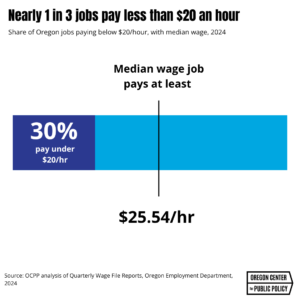
The struggles of Oregon families to make ends meet are, to a large extent, a problem of wages being too low. In 2024, Oregon’s typical (median) wage of $25.54 per hour was not enough for most families with children to cover the bare minimum. By definition, half of all jobs pay less than the median, and a significant share — about 30 percent — paid less than $20 per hour, an amount insufficient to cover a survival budget for even a single person with no children.
The fact that so many jobs fail to pay enough for families to cover basic necessities reveals structural problems with the economy. Although the economy continues growing, most of those gains are flowing to those at the top.[1] As state lawmakers look to support broader economic prosperity and growth, they must focus on policies that support hardworking Oregon families. These include policies that improve the ability of workers to negotiate for better pay and working conditions, directly boost worker income, and lower the cost of basic needs.
The typical (median) wage is not enough for most families with children
For most working Oregonians, the vast majority of their income comes from a paycheck.[2] In 2024, the median hourly wage in Oregon was $25.54. This means that half of all jobs paid less than $25.54, and half paid more.[3]
Among families with children, a full-time job paying the median wage was not enough to cover basic necessities. The United Way developed the Asset Limited, Income Constrained, Employed (ALICE) methodology to estimate how much households need to afford the essentials of modern life — a “survival budget.”[4] Although ALICE does not cover every possible household type, the findings show that any household raising more than one child needs far more than a full-time job paying the median wage to survive. In 2024, a two-parent family raising two children needed an hourly wage of $37.99 working full-time, according to ALICE. That wage is 49 percent higher than the median wage.[5]
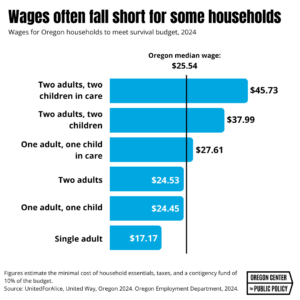
For a single parent raising one child, the situation was similarly bleak. If the child was in child-care, the median wage fell short of the $27.61 needed under the survival budget. Even for a single parent without the need for child care, the Oregon median wage was barely enough to cover their essential needs.[6]
The figures above reflect what it takes to scrape by, as opposed to achieve financial stability. ALICE separately provides estimates of the amount it takes to reach a “stability budget” for households. This budget includes the ability of families to save, which is essential for moving beyond scraping by and getting to longer-term stability. That analysis shows that, in 2024, a full-time job paying the median wage was not enough for any type of household, including single adults, to achieve stability.[7]
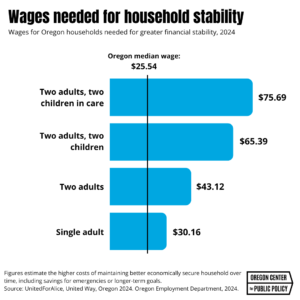
Of course, by definition half of all jobs pay less than the median wage, and many of those pay significantly less. About 30 percent of all jobs in Oregon – more than 905,000 in total – paid less than $20 per hour in 2024. Only for a single adult would a full-time job paying $20 per hour had been enough to meet a survival budget, according to the ALICE Index. But that job would still have fallen well-below the $30.16 per hour that this person would have needed to achieve a financially stable budget.[8]
Some groups are more likely to toil in low-paying jobs than others
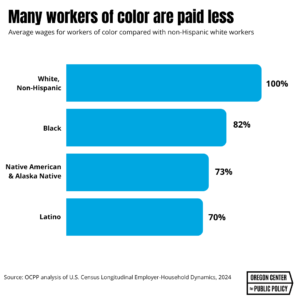
Some communities of color are more likely than others to labor in low-paying jobs. This is driven by past and present government policies limiting the educational and economic opportunities that enable people to access lucrative jobs, as well as by workplace discrimination.[9]
In 2024, the year with the most recent data available, the average wages of Black and brown workers in Oregon were significantly less than that of non-Hispanic white workers.[10] Specifically, Black workers were paid 82 percent of what non-Hispanic white workers were paid. American Indian and Alaska Native and Latino workers were paid 73 and 70 percent respectively of their white peers.
Women, too, were more likely to work in low-paying jobs. The long-standing gender wage gap in Oregon persisted in 2024. Oregon has taken steps to address pay inequities, including enacting the Equal Pay Act in 2017. Yet, in 2024, Oregon women were paid 86 cents on the dollar of what men were paid.[11]
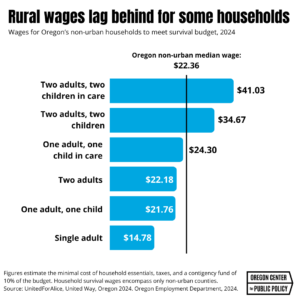
Although poor-quality jobs are found across the state, jobs in rural Oregon are more likely to pay too little to meet basic needs, compared to jobs in urban areas. The cost of living tends to be lower in rural areas. In 2024, the household survival budgets for rural Oregon counties were 9 to 16 percent lower than the survival budget for the state as a whole, depending upon household composition.[12] At the same time, wages in rural areas tend to be lower than those for the state.[13] For example, in 2024, wages in Umatilla County were 21 percent lower than wages overall in Oregon.[14]
Poor quality jobs are concentrated in certain industries, including some essential industries
Jobs that pay low wages tend to be found in particular industries, including some industries vital to the well-being of Oregonians and the functioning of the state.
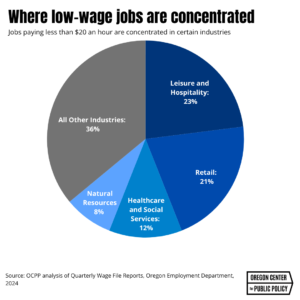
- Leisure and hospitality. This includes restaurants, fast food places, hotels, motels, and other places that provide food or lodging.[15] The leisure and hospitality industry is a hot spot for low-wage jobs. In 2024, a typical job in this industry paid $19.33. And nearly one of every four jobs in the state paying less than $20 per hour were leisure and hospitality jobs.[16] Looking at particular jobs in the industry, the median wage (including tips) for servers in 2024 was $16.31 per hour and for housekeepers the figure was $16.92.[17]
- Retail. These businesses engage in selling goods directly to the general public – such as grocery, sporting goods, pharmacies, and department stores.[18] Retail also has many low-wage jobs. In 2024, retail workers typically earned $19.21 and one in five jobs paying less than $20 per hour was in retail.[19] In 2024, the typical wage for non-supervisory retail salespersons and cashiers were $17.37 and $16.50, respectively.[20]
- Healthcare and Social Services. This sector includes jobs that provide either medical care or services.[21] In 2024, this industry had a higher median wage at $25.87, thanks to higher paying jobs like nursing and counseling.[22] But other vital jobs like home care and childcare paid much less, $19.92 and $17.78 per hour, respectively.[23] This helps explain why this industry made up 12 percent of all jobs that paid under $20 per hour in 2024.[24]
- Natural Resources. This industry includes businesses engaged in farming, forestry, hunting, and mining.[25] Although natural resources makes up a smaller share of low-wage jobs, it still accounts for 8 percent – about 1 in every 12 jobs – paying under $20 per hour. The typical worker employed in natural resources earned $19.78 per hour in 2024.[26] Farmworkers – essential to the wellbeing of Oregon’s economy – typically earned $16.36 per hour in 2024, well below the “survival budget” for most families according to the ALICE Index.[27]
Although these median wage levels were above Oregon’s minimum wage at the time, it’s hard to imagine they afforded workers the opportunity to live free of economic hardship or invest in their own and their family’s future.
Recent wage increases don’t change the game
Though wages have been rising, this welcome development does not fundamentally change the fact that many jobs pay too little to cover the cost of basic needs.
Looking at the last several years, Oregon has seen the gains of higher median wages absorbed by inflation. From 2020 to 2024, the median hourly wage increased from $19.97 to $25.54. This 28 percent growth, after factoring in inflation, shrinks to 6.1 percent. In other words, the rising cost of living ate up most of the gains from better pay.
More recent industry data shows even weaker gains for workers in low-wage industries. Oregon Employment Department data shows that from early 2024 to early 2025, median wages in the leisure and hospitality industry, natural resources, and retail trade experienced 2.6 to 3.4 percent increases – ranging from 51 cents to 69 cents per hour before inflation. After accounting for inflation though, wages in natural resources and retail trade increased by less than 1 percent in real terms over that period, while leisure and hospitality experienced a decline in real wages.[28]
Ultimately, the gap between what many lower-wage jobs pay and what workers need to survive remains wide. For instance, a single cashier working full time making $15.15 per hour — a wage one in four Oregon cashiers earns or falls below — would need a 13 percent boost just to meet their basic needs. But to support a pre-school-age child, that cashier would need an 82 percent wage boost.[29]
Oregon should act to make sure the economy works for working families
Oregon can and should take steps to improve wages and ensure shared prosperity. The following is an outline of some of the steps Oregon can take to improve the economic security of working Oregonians.
- Improve workers ability to negotiate for better pay and working conditions. Workers are better able to secure higher wages, stronger benefits, and safer working conditions when they can join unions and bargain collectively. Yet many workers face employer intimidation, while others workers — farmworkers, domestic workers, and independent contractors — are excluded from key labor protections.[30] Oregon can strengthen workers’ ability to have to better pay and benefits by extending the right to organize to excluded workers and establishing just-cause protections against unfair firings. And in industries where workers are dispersed and unionization is especially difficult, Oregon should create workforce standards boards to recommend wage levels and benefits for the entire sector.[31]
- Directly boost worker income. Oregon can take steps that directly boost the take-home pay of workers. This includes continuing to increase the minimum wage, with the goal that every full-time worker is able to secure a safe and decent standard of living. Oregon should also expand programs that provide unconditional cash supports to households struggling to meet basic needs. Lawmakers should continue to strengthen and improve tax credits such as the Oregon Kids’ Credit and Earned Income Tax Credit to support more low- and moderate-income families to make ends meet.[32]
- Offset the cost of basic needs. Lowering the cost of basic needs is another way to help families make ends meet. A key driver of household costs with children is the cost of child care. Oregon should invest in a robust system of child care so that all families have high-quality care they can afford. Oregon should also move toward universal health care, so all Oregonians have affordable health coverage. Finally, Oregon should continue investing in housing stability and affordability, including rental assistance and affordable housing for working families and extremely low-income households.[33]
Conclusion
The prevalence of low-wage jobs is a fundamental reason why so many Oregonians struggle to cover basic needs. Oregon can take decisive steps to boost wages, allowing households to meet their basic needs through policies that improve workers’ ability to negotiate for better pay and working conditions, boost worker incomes, and make basic necessities more affordable.
—
[1] Tyler Mac Innis and Juan Carlos Ordóñez, Oregon Economy: Strong Growth, Uneven Gains, Oregon Center for Public Policy, May 12, 2026.
[2] About 93 percent of Oregonians derive their income from a paycheck. 2024 American Community Survey 1-Year Estimates, Oregon.
[3] OCPP analysis of Quarterly Wage File Reports, Oregon Employment Department. Because short-term and seasonal work generates more distinct job records, the annual median is generally lower than the median for any individual quarter.
[4] United For ALICE, United Way.
[5] The figures for households with children assume school-age children and after-school child care costs. Households with younger children have higher child care costs and require a higher survival budget wage. The State of Alice in Oregon, United for Alice. The index provides specific figures for households of different sizes and geographical locations.
[6] The State of Alice in Oregon, United for Alice.
[7] Ibid.
[8] OCPP analysis of Quarterly Wage File Reports, Oregon Employment Department. The State of Alice in Oregon, United for Alice.
[9] William Sites, Virginia Parks, What Do We Really Know about Racial Inequality? Labor Markets, Politics, and the Historical Basis of Black Economic Fortunes Sage Journals, March 3, 2011.
[10] The data source for wages by race are average wages and, therefore, not strictly comparable to median wage figures shown elsewhere in this report. In 2024, the average hourly wage for Black workers was $29.54. For Latinos it was $25.42, American Indian or Alaskan workers it was $26.20, and for non-Hispanic whites it was $36.12.
[11] U.S. ACS 2024 1-Year Estimates, U.S Census Bureau of Labor Statistics, Highlights of women’s earnings in 2024, 2017 Regular Session – HB 2005, and Anna Marum, Oregon Democrats (and one Republican) pass equal pay bill out of the House, The Oregonian, March 29th, 2017.
[12] OCPP analysis of UnitedforAlice.org data. Rural counties are those under the Non-urban minimum wage standard.
[13] OCPP analysis of the U.S. Census Bureau, 2020–2024 American Community Survey 5-Year Estimates.
[14] OCPP analysis of the U.S. Census Bureau, 2024 American Community Survey 1-Year Estimates.
[15] U.S. Bureau of Labor Statistics, Accommodation and Food Services: NAICS 72.
[16] OCPP analysis of Quarterly Wage File Reports, Oregon Employment Department.
[17] Occupational Employment Statistics (OES) Survey, May 2024 OEWS Estimates for Oregon, Bureau of Labor Statistics.
[18] U.S. Bureau of Labor Statistics, Retail Trade: NAICS 44-45.
[19] OCPP analysis of Quarterly Wage File Reports, Oregon Employment Department.
[20] Occupational Employment Statistics (OES) Survey, May 2024 OEWS Estimates for Oregon, Bureau of Labor Statistics.
[21] U.S. Bureau of Labor Statistics, Heath Care and Social Assistance: NAICS 62.
[22] OCPP analysis of Quarterly Wage File Reports, Oregon Employment Department.
[23] Occupational Employment Statistics (OES) Survey, May 2024 OEWS Estimates for Oregon, Bureau of Labor Statistics.
[24] OCPP analysis of Quarterly Wage File Reports, Oregon Employment Department.
[25] U.S Bureau of Labor Statistics, Natural Resources and Mining super sector.
[26] OCPP analysis of Quarterly Wage File Reports, Oregon Employment Department.
[27] Occupational Employment Statistics (OES) Survey, May 2024 OEWS Estimates for Oregon, Bureau of Labor Statistics and The State of Alice in Oregon, United for Alice
[28] OCPP analysis of Quarterly Wage File Reports, Oregon Employment Department.
[29] One in four cashiers in Oregon were paid $15.15 per hour or less in 2024. OCPP analysis of Occupational Employment Statistics (OES) Survey, May 2024 OEWS Estimates for Oregon, Bureau of Labor Statistics.
[30] Tyler Mac Innis and Janet Bauer, Oregon Should Ensure All Workers Have the Right to Organize, Oregon Center for Public Policy, August 30, 2023. and Kathy Lara, Oregonians Need Just-Cause Employment, Oregon Center for Public Policy, January 15, 2026.
[31] Kathy Lara, Workforce standards boards can raise the tide for all workers, Oregon Center for public Policy, September 4, 2024.
[32] Tyler Mac Innis, Oregon Guaranteed Income Pilots Offer a Blueprint for a Better Safety Net, Oregon Center for Public Policy, April 28, 2026 and Tyler Mac Innis, Oregon Can Respond to the Affordability Crisis by Expanding the Oregon Earned Income Tax Credit, February 3, 2026. Oregon Center for Public Policy, Action Plan for the People, 2024.
[33] National Low-Income Housing Coalition, Housing Needs by State: Oregon.