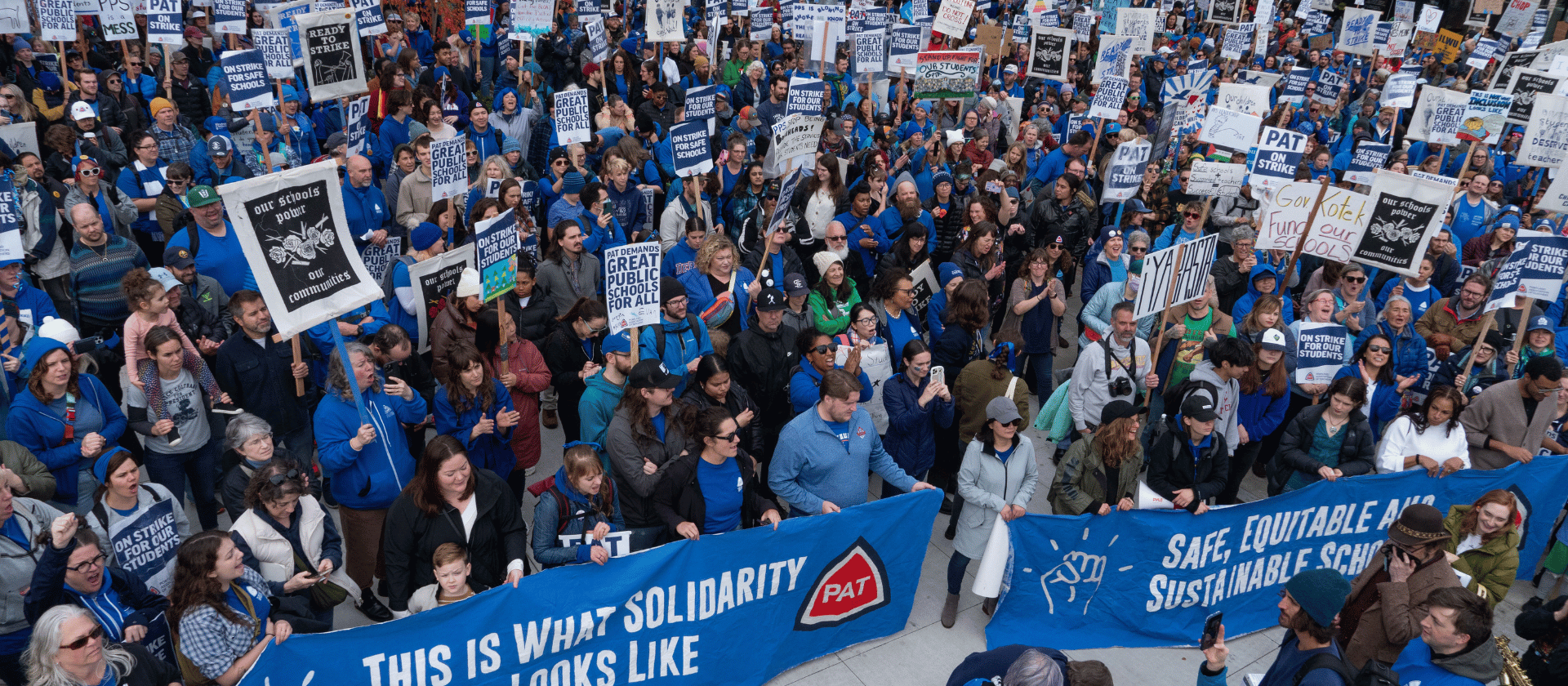

For decades, Oregon has resisted calls to replace some of its income taxes with a sales tax. Now, that idea is back — with Governor Tina Kotek’s Prosperity Council calling for an overhaul of Oregon’s tax code that could mean lower income tax rates and the establishment of a sales tax.
What happens when states follow that path? In this episode of Policy for the People, we look at what’s happened in states that have cut income taxes while increasing their reliance on sales taxes. The results are striking: tax systems have become more regressive, shifting more of the burden onto working families.
We hear from analyst Sarah Austin of the Institute on Taxation and Economic Policy about the national trend, and from Alexandra Sirota of the North Carolina Budget and Tax Center about her state’s decade-long experiment with cutting income and corporate taxes. North Carolina has ranked among the nation’s top states for business — but its tax cuts have failed to deliver the promised economic boom and have contributed to growing fiscal challenges and underfunded public services.
As Oregon considers changes to its tax system, the question is simple: Will Oregon follow North Carolina’s path, or instead choose the path that asks more from those who can most afford to pay?
Listen to prior episodes of the show
Follow Policy for the People on your favorite podcast app



Transcript
[We make this transcript available for your convenience and to increase the accessibility of our content. The transcript was generated by software and was slightly edited for clarity. If you are able to, we encourage you to listen to the recording.]
(Juan Carlos Ordóñez, host and narrator): An old idea for changing Oregon’s tax system is once again being talked about. Over the decades, corporate lobbyists and others have argued that Oregon should reduce its reliance on the income tax by establishing a sales tax. Oregon, of course, is one of the few states in the nation that doesn’t have a broad-based sales tax.
This idea resurfaced recently in the recommendations of the Oregon Prosperity Council, a panel convened by Governor Tina Kotek.
While for decades Oregonians have resisted the idea of cutting income taxes and offsetting the loss of revenue with the creation of sales tax, the opposite has been true in many other states, to the detriment of working families in those states.
In this episode of Policy for the People, we explore what Oregon can learn from what’s been happening across the country in states that have chosen to cut personal income taxes and tried making up some of the loss of revenue by increasing sales taxes. No state exemplifies this approach more than North Carolina.
What does cutting income taxes and trying to replace the loss of revenue with sales taxes mean in terms of who pays the taxes that go to support public services like education and health care? Who wins and who loses from changing the tax system in this way?
Stay tuned . . .
At the start of the year, Oregon Governor Tina Kotek convened a panel made up mostly of representatives from the corporate sector to study how to “improve Oregon’s business climate.” This panel, called the Oregon Prosperity Council, issued its recommendations in late June.
The Prosperity Council’s recommendations covered a lot of ground, including changes to Oregon’s tax system. For the 2027 legislative session, the Council recommended several tax cuts that, as critics have pointed out, would mainly benefit investors, the wealthy, and corporations.
But these specific proposals were not the most important piece of the Prosperity Council’s recommendations when it came to taxes.
“The most important thing that needs to happen is to ask the Governor to convene a bipartisan group to go off and really overhaul the entirety of our tax code in Oregon.” That was Renée James, one of the co-chairs of the Prosperity Council, speaking to KGW News.
The document released by the Prosperity Council doesn’t provide much detail on what such an overhaul of Oregon’s tax code might look like, but it does offer some clues as to what could be on the table for discussion.
The Prosperity Council said the state needs to “reduce effective rates for all income brackets.” It added that “Achieving a more balanced and competitive tax system may require broader-based revenue tools that can be more regressive in isolation.”
That’s dense, wonky language for sure. Broader-based revenue is a phrase that refers to a sales tax. So what the Prosperity Council seems to be saying is that Oregon should cut personal income taxes across the board, while at the same time putting in place a sales tax.
This is not a new idea. Cutting personal income taxes and making up the difference with a sales tax is something that corporate lobbyists and others in Oregon have argued for in the past and even recently.
Taxes are how we fund the public services that benefit everyone: the school our children attend, the transportation system that allows us to get here and there, much of the health care that people receive, and on and on. Without a tax system, there wouldn’t be much of what we would call a state or nation. As U.S. Supreme Court Justice Oliver Wendell Holmes said nearly a century ago, “taxes are what we pay for a civilized society.”
But it’s also important to recognize that not all taxes are created equal. Some taxes weigh more heavily on working families – they take a bigger share of their income than of the income of the rich. These are called “regressive taxes.” The opposite of regressive taxes are progressive taxes, which ask proportionately more of the rich than of middle- and low-income families.
As a general rule, sales taxes are regressive. For example, if a rich person and a poor person both pay the same to buy new tires for their car, the amount they pay in sales taxes is the same, but the hit from the sales tax to family finances is much bigger for the poor family than the rich family.
By contrast, income taxes can be structured progressively, by increasing the tax rates the higher you go up the income ladder. You can make income taxes – whether for people or corporations – take into account the reality of how much the taxpayer makes, and ask proportionately more of those with the highest incomes.
At a time when economic inequality has been rising to record levels, at a time when the rich have been getting richer and middle and low-income families have been struggling, you would think that state policymakers would be working hard to make tax systems more progressive. That they would be raising taxes on the rich and reducing taxes on the poor.
But the reality is that more often than not, states have been going in the opposite direction.
(Sarah Austin): “There have been some pretty clear trends. We see that the more regressive choice, the choice that’s going to push more costs onto working families, is the one that lawmakers have overwhelmingly been choosing when faced with tax policy decisions.”
That’s Sarah Austin, a senior analyst at the Institute on Taxation and Economic Policy (ITEP). ITEP is a non-profit, non-partisan tax policy organization. A lot of their research focuses on how federal and state taxes affect people at various levels of income and wealth, and people of different races and ethnicities.
Recently, Sarah was interested in looking at whether tax systems in the various states have changed over the long-haul. Have they gotten more progressive or more regressive?
(Sarah): The Institute on Taxation and Economic Policy has built a really complex simulation model for every state, looking at every piece of their tax code. And this gives us really useful data to know how much taxes are going to raise and how they ask different people with different income levels to contribute more or less to raising those funds.
But that kind of comprehensive look back to 1901 would be a massive, massive undertaking and one that I am not built to do. So instead, what I did is looked at top income tax rates. These are ones that typically apply to wealthier households. There are some states that have just a single rate, but wealthy households are always going to be paying the top rate of income taxes.
Same with profitable corporations. And then sales taxes, on the other hand, are paid disproportionately by poor households. And what we see when we analyze sales taxes is that poor households are actually paying multiple times the amount of sales taxes as a share of their income than the wealthiest do. So by focusing on top income tax rates and on sales tax rates, what we have is a rough proxy for understanding states are becoming more or less reliant on working families to fund priorities versus the wealthiest.
And what Sarah found in her research is that states are becoming more reliant on working families to fund public services. On the whole, the tax systems of the states have become more regressive over time.
One way to see this trend, she said, is to consider what has happened with the prototypical state – the median state.
(Sarah) We’ve seen that the median state, which is like if you line the states up with the biggest tax rate at the top and the lowest or no tax rate at the bottom, plucking out that middle state and seeing what their rate is at the median. We’ve seen that personal and corporate income tax rates are substantially lower than they were in 1990. So for individual income taxes since 1990, the median rate has fallen from 6 to 4.6%, and the median corporate tax rate has fallen from 7.2% to 5.9% over that same period. So those are the taxes that are most effective at taxing wealthy people and profitable like huge corporations.
We’ve seen those rates decline, while at the same time, the median state sales tax rate has increased from 5 to 6%, which is the tax that has the biggest impact on the family struggling the most to get by. So these are not encouraging trends for people that care about working people and their ability to succeed in the economy.
To be clear, it’s not the case that in every instance states have changed their tax system to reduce taxes on the wealthy and corporations, or raised sales taxes that weigh more on working people. It’s just that when states have made changes, more often than not that has been what they’ve done.
Since 1990, the results are pretty shocking. State lawmakers have cut top personal income tax rates 210 times versus increasing them 73 times for corporate taxes. They have cut them 168 times versus increasing them only 42 times.
And on sales taxes, we’ve seen lawmakers increase rates 68 times while decreasing them just 29.
In some cases, Sarah said, state lawmakers have ordered the full menu when it comes to making their tax system more regressive. They have cut tax rates for the richest people in the state and for corporations, while also raising sales taxes that weigh more heavily on working families.
(Sarah): There are 11 states in particular that have done the full combination of these policies that have decreased their top personal and corporate income tax rates while increasing their sales tax rate.
I asked Sarah if there is a state that really stands out in her research, in terms of taking its tax code in a more regressive direction.
(Sarah): I think really anyone making policy decisions should pay a lot of attention to North Carolina.
North Carolina. The Tar Heel State.
For Oregonians who have been closely following the debates around Governor Kotek’s Prosperity Council, it may be especially interesting to hear Sarah cite North Carolina as the poster child of tax policy gone awry.
In the lead-up to the creation of the Oregon Prosperity Council, Governor Kotek published a document called the Prosperity Roadmap. One of the goals set out in the Governor’s Prosperity Roadmap was to make Oregon appear as one of the top 10 states in CNBC’s Top States for Business. This index, published by CNBC, the cable news company, purports to measure the so-called “business climates” of states and rank states accordingly. At the time that the Governor’s Prosperity Roadmap came out, CNBC ranked North Carolina as having the nation’s top business climate in the nation. In the ranking that came out recently, North Carolina was ranked #2.
Oregon Business and Industries, the lobby for the biggest corporations in the state, often cites Oregon’s poor showing on the CNBC index of Top States for Business to argue that Oregon’s economy has become uncompetitive and to argue for cutting taxes on corporations and the wealthy.
But is there a different lesson to be found in the fact that North Carolina ranks so highly in the CNBC index?
(Alexandra Sirota): I would just lift up North Carolina as a cautionary tale.
That’s Alexandra Sirota. She is the executive director of the North Carolina Budget and Tax Center. The organization works to document and analyze fiscal and economic conditions in the state.
For more than a decade, North Carolina has been cutting personal income taxes and corporate income taxes, while expanding its sales tax.
(Alexandra): The promise of income tax cuts delivering an economic boom and a better life has not delivered for North Carolinians, and it would be a mistake to use North Carolina as a case example for good policy making.
As Alexandra explains it, the story begins in 2012, when national groups – groups from outside of North Carolina – began trying to convince state lawmakers to make drastic changes to the state’s tax system.
(Alexandra): A number of national organizations with ideologies that emphasize the benefiting the rich and profitable corporations, and the idea that delivering better conditions for them to thrive would help us all, came to North Carolina and convinced state legislators that we needed to eliminate the income tax.
So that proposal was roundly rejected by a group of bipartisan legislators in 2013. Because of the real clear story that was told about what the cost would be, both in terms of loss of service and the need to raise other taxes and fees.
But what it did usher in was a massive overhaul of our tax code in 2013, which meant legislators passed and adopted a flat income tax rate, removed many credits and deductions from our income tax code, and expanded the base of the sales tax to more services. As part of this effort, they also began to reduce corporate income taxes, and the real push has been since that time to continue to focus on income tax rates and bringing those down as much as possible for the past decade.
It’s clear who has benefited from the tax cutting spree that the North Carolina legislature has pursued.
(Alexandra): Our estimates are that two out of $3 in personal income tax cuts are going to the richest 20% of North Carolinians. So that was one change on the income tax side. The other change was a reduction in the corporate income tax rate. And by 2030, North Carolina will completely eliminate the tax on corporate profits.
So what has been the result of all the tax cutting favoring the wealthy and corporations?
(Alexandra): The tax changes here in our state have put us on a path to financial ruin.
It’s really put our state into an ongoing challenge of balancing a budget and even passing a budget. It took more than a year last year to pass a budget. We missed an entire fiscal year in North Carolina because legislators couldn’t agree on the tax plan.
So it’s had real ripple effects in our communities. And what it hasn’t done is delivered any real economic boost.
We are continuing to perform on key measures of economic progress like employment growth, wage growth, in line with our neighbors. We have not seen the promised expansion of opportunity to communities, particularly rural communities across our state, which continue to recover from job losses during the Great Recession and the Covid 19 pandemic.
We’ve also seen that the state has failed to meet the constitutional requirement to fund every child’s basic education in our K through 12 public education system. And that’s meant, you know, a generation of kids are growing up in classrooms that aren’t adequately funded, where teachers are not paid a competitive rate, and we have high levels of vacancy.
We’ve lost state funding for teaching assistance in the classroom to support young kids reading success. And we have left a number of updates to facilities unpaid. And that has meant kids are going to school in classrooms with mold, with leaking roofs, without the heating and cooling that in a state like North Carolina, particularly in the fall and spring, cooling is important to keep kids in the classroom.
So there’s been some pretty real impacts on people’s experiences and ability to learn and earn and contribute to the communities where they want to stay, where they want to live a good quality life. But the ability to do that is being undermined by our state. Legislators focus on an income tax rate reduction over the priorities communities have.
The difficult fiscal and economic picture facing North Carolina is not what one imagines when they see the state ranked as number one or number two for business, which is how North Carolina appears in the CNBC rankings – the rankings, again, touted so much by Oregon’s business lobby.
This is how Alexandra explains the disconnect between the CNBC business rankings and the reality on the ground in her state.
(Alexandra): I think the issue with rankings is that they often measure things that reflect the priorities of who is doing the ranking. And in this, see CNBC ranking in particular. What we know is that on marks such as tax, low tax rates, low regulation, we rank higher. But if you dig into that measure, one of the reasons that we’re also ranked high is that we’ve been able to ride on the legacy of investment in our public university and job training programs.
At community colleges we’ve been able to support, so that’s boosted our ranking as well. And where we fall short on that ranking is in places like quality of life and investment in the workforce. So I think the bottom line on these rankings is they tend to reinforce an idea that when we support businesses, we’re supporting the broader economy, but we know that our economy is driven by the people who show up every day to provide food on the tables of millions of households across our state who care for our elders and hospitals and child care settings, who educate our children and who serve our communities as firefighters, as retailers and those people and their well-being is what will generate the kind of sustainable economy that we know we need in North Carolina. And unfortunately, business rankings by nature don’t consider the fact that a businesses success is dependent on how well workers and people are doing in a community.
While North Carolina finds itself in a difficult fiscal and economic situation, Alexandra finds reason for hope.
(Alexandra): My optimism is that people are actively engaging in efforts to make sure that our tax code gets fixed. In North Carolina this past year, we had bills introduced to raise a millionaire’s tax, a tax on income over $1 million to make sure we could fund some of the priorities in public schools.
This past year, we had a bill called the Kids Over Corporations Act, which would raise our corporate income tax rate to be in line with our neighbors. Again, a lot of what we’re talking about in North Carolina is that these are common sense steps that we can take to make sure that we everyone is paying what they owe millionaires and profitable corporations, along with everyday people, to make our communities successful and a good place to live.
The Kids Over Corporation Act would put the corporate income tax rate at 5% in line with our neighbors, and allow us to raise $2 billion in revenue that could immediately boost our pay for teachers to the national average, and ensure that the state is actually funding teaching positions that they’ve increasingly pushed onto local governments to fund. So we have I think the optimism is that we have the capacity and the wealth in our state to fund communities that really deliver shared prosperity.
We just need the will of our elected leaders to understand that that’s how we strengthen our state, that’s how we strengthen our democracy, and that’s how we deliver for people on the things that matter most to them well-being and affordability.
Sarah Austin, the analyst from the Institute on Taxation and Economic Policy, also sees reason for hope. She points to the fact that in recent years a number of states – Massachusetts, Washington, Maine and others – have chosen the progressive path. State legislatures there have opted to raise taxes on the wealthy in order to better fund public services.
(Sarah): Particularly recently, a number of states have chosen a different path. We’ve seen states in the last six or so years strengthening progressive revenue sources by asking more of high income households. But these have been outnumbered by tax cutting states. But it does show that policymakers have a real choice in front of them. It’s not the default decision just to cut.
It’s not inevitable. There are states out there that are making other choices that are better able to invest in their people and their economy, their communities, because of the choices that they’re making.
I think there is a role that state tax policy has played in kind of worsening inequality and a real missed opportunity that state policy has played in not helping with affordability for people who are struggling. So turning that around, there’s a lot of opportunity for states to be looking at progressive revenue raisers, things that ask the rich to shoulder the biggest part of the cost, to then reinvest in things that make the economy more affordable for everyone.
I do have reason for hope, seeing these states in the last few years that I’ve kind of taken this on this guy has not fallen. The fear mongering of the anti-tax lobby is starting to crack, as more states kind of take a step forward and realize the potential a progressive revenue and the investments of people that are possible when they decide to tax the rich.
Most of the polls that I’ve seen show broad support for particularly taxing corporations more, but also taxing wealthy people more as well.
So I have an ounce of hope, looking forward, that states are going to kind of diverge from this past three years or so decades of tax policy that has been trending in a more regressive direction, and as a more examples of states succeeding with this kind of our talked about in the media, as you can see, that the states bring in more revenue, that they’re able to bolster programs that matter, that other states will follow.
That’s what I hope for.
Like all states across the country, Oregon has a decision to make.
At a time of extreme economic inequality, when the rich have accumulated income and wealth like never before, will Oregon follow the example of states like North Carolina that have pursued tax cuts favoring the rich and corporations? Will the state enact a sales tax that weighs more heavily on working families, acceding to the demands of Oregon’s corporate lobbyists?
Or will Oregon choose the path that other states have taken, states that have raised taxes on the rich to strengthen public services that benefit everyone?
Only time will tell, but whichever path Oregon chooses, it is a decision that will affect the quality of life for this and future generations of Oregonians.
I want to thank Sarah Austin of the Institute on Taxation and Economic Policy and Alexandra Sirota of the North Carolina Tax and Budget Center for their time and insights that made this episode possible.
And thank you for listening to Policy for the People. We will see you next time.