Only the richest five percent of Oregonians are better off from the tax changes enacted by the Trump administration and the congressional Republican majority, according to a new analysis by the Institute on Taxation and Economic Policy (ITEP). The other 95 percent of Oregonians, those making less than $330,000 per year, are worse off, paying more in taxes. And the less income you have, the worse it gets.
ITEP analyzed the combined impact of the Trump administration’s three biggest changes in tax policy so far. These include the tax changes in H.R. 1, the so-called One Big Beautiful Bill Act, the expiration of Enhanced Premium Tax Credits (EPTC), and wave after wave of tariffs. This is what the combined effect of these three changes looks like:
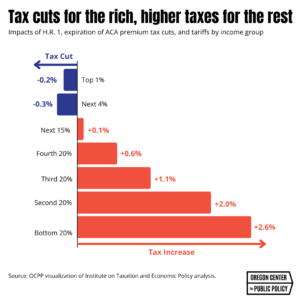
The result shown above is what happens when you enact a massive tax package where the main beneficiaries are the rich, when you take away health care tax credits from working families, and when you implement tariffs that raise costs on everyone.
H.R. 1: Huge tax cut mainly for the rich
In a flurry of upside-down redistribution, the Trump administration and congressional Republicans passed H.R.1 in July of 2025. This tax and budget package heavily cut the taxes of the richest people while delivering meager benefits to working families. In Oregon, the tax cuts amount to more than $42,000 for the richest 1 percent, while the lowest-earning 20 percent will average a $70 benefit. Worse still, H.R. 1 partially pays for the tax cuts by slashing support for Medicaid and food assistance from low- and moderate-income families. Unsurprisingly, the massive tax cuts going to the rich are the reason why the top five percent end up better off, even with the increased costs of imported goods due to tariffs.
Expiration of Enhanced Premium Tax Credits: a tax increase for many working families
Oregonians who purchase health insurance in the Oregon Health Insurance Marketplace just saw a big tax increase due to deliberate inaction by Congress. Enhanced Premium Tax Credits (EPTC) have been a crucial tool in helping working families and small business owners afford healthcare by subsidizing the cost of health insurance purchased on the open market. However, Congress let them expire at the end of 2025, leaving tens of thousands of Oregonians without any support affording premiums and over 100,000 Oregonians with more expensive health insurance. In aggregate, this hurts the economic security of the lowest-earning 60 percent of Oregonians who are not on the Oregon Health Plan and instead have health insurance through the Marketplace.
Tariffs: a tax increase on everyone
Tariffs are taxes on imports that are largely paid for by consumers. Over the past year, the Trump administration has implemented waves of tariffs, walked some back, and increased them again. After the Supreme Court recently struck down one set of tariffs on the basis that the administration lacked the authority to implement them under the International Emergency Economic Powers Act, the Trump Administration cited a different statute in announcing 15 percent tariffs across the board.
As a share of the economy, Trump’s tariffs are the biggest tax increase on Americans since 1982. And that tax increase is disproportionately borne by low- and middle-income working families here in Oregon and across the nation, making it the largest driver of why the combined impact of these policies is so upside-down.
In sum, the net effect of the tax policies enacted thus far by the Trump administration and the Republican majority in Congress is tax cuts for the rich, higher taxes for everyone else.

Tax cuts for the rich, higher taxes for everyone else: the net effect of Trump’s tax policies
Tax cuts for the rich, higher taxes for everyone else: the net effect of Trump’s tax policies
Tax cuts for the rich, higher taxes for everyone else: the net effect of Trump’s tax policies
Only the richest five percent of Oregonians are better off from the tax changes enacted by the Trump administration and the congressional Republican majority, according to a new analysis by the Institute on Taxation and Economic Policy (ITEP). The other 95 percent of Oregonians, those making less than $330,000 per year, are worse off, paying more in taxes. And the less income you have, the worse it gets.
ITEP analyzed the combined impact of the Trump administration’s three biggest changes in tax policy so far. These include the tax changes in H.R. 1, the so-called One Big Beautiful Bill Act, the expiration of Enhanced Premium Tax Credits (EPTC), and wave after wave of tariffs. This is what the combined effect of these three changes looks like:
The result shown above is what happens when you enact a massive tax package where the main beneficiaries are the rich, when you take away health care tax credits from working families, and when you implement tariffs that raise costs on everyone.
H.R. 1: Huge tax cut mainly for the rich
In a flurry of upside-down redistribution, the Trump administration and congressional Republicans passed H.R.1 in July of 2025. This tax and budget package heavily cut the taxes of the richest people while delivering meager benefits to working families. In Oregon, the tax cuts amount to more than $42,000 for the richest 1 percent, while the lowest-earning 20 percent will average a $70 benefit. Worse still, H.R. 1 partially pays for the tax cuts by slashing support for Medicaid and food assistance from low- and moderate-income families. Unsurprisingly, the massive tax cuts going to the rich are the reason why the top five percent end up better off, even with the increased costs of imported goods due to tariffs.
Expiration of Enhanced Premium Tax Credits: a tax increase for many working families
Oregonians who purchase health insurance in the Oregon Health Insurance Marketplace just saw a big tax increase due to deliberate inaction by Congress. Enhanced Premium Tax Credits (EPTC) have been a crucial tool in helping working families and small business owners afford healthcare by subsidizing the cost of health insurance purchased on the open market. However, Congress let them expire at the end of 2025, leaving tens of thousands of Oregonians without any support affording premiums and over 100,000 Oregonians with more expensive health insurance. In aggregate, this hurts the economic security of the lowest-earning 60 percent of Oregonians who are not on the Oregon Health Plan and instead have health insurance through the Marketplace.
Tariffs: a tax increase on everyone
Tariffs are taxes on imports that are largely paid for by consumers. Over the past year, the Trump administration has implemented waves of tariffs, walked some back, and increased them again. After the Supreme Court recently struck down one set of tariffs on the basis that the administration lacked the authority to implement them under the International Emergency Economic Powers Act, the Trump Administration cited a different statute in announcing 15 percent tariffs across the board.
As a share of the economy, Trump’s tariffs are the biggest tax increase on Americans since 1982. And that tax increase is disproportionately borne by low- and middle-income working families here in Oregon and across the nation, making it the largest driver of why the combined impact of these policies is so upside-down.
In sum, the net effect of the tax policies enacted thus far by the Trump administration and the Republican majority in Congress is tax cuts for the rich, higher taxes for everyone else.
Daniel Hauser
Action Plan for the People
How to Build Economic Justice in Oregon
relevant topics
Oregon, Beware: North Carolina Shows Where This Tax Road Leads
The path to shared prosperity begins with Oregon workers
Many Jobs Pay Too Little to Support a Family
Action Plan for the People
How to Build Economic Justice in Oregon
Latest Posts
Oregon, Beware: North Carolina Shows Where This Tax Road Leads
The Oregon Prosperity Council is reviving an old idea for reforming Oregon’s tax system in a way that would shift taxes away from the rich and corporations and onto working families.
The path to shared prosperity begins with Oregon workers
When working people have power in the workplace, the rising tide truly lifts all boats.
Many Jobs Pay Too Little to Support a Family
The fact that many jobs pay too little is a fundamental reason why so many Oregonians struggle to cover basic needs.
Your donation helps build Economic Justice in Oregon
Your donation helps build Economic Justice in Oregon