
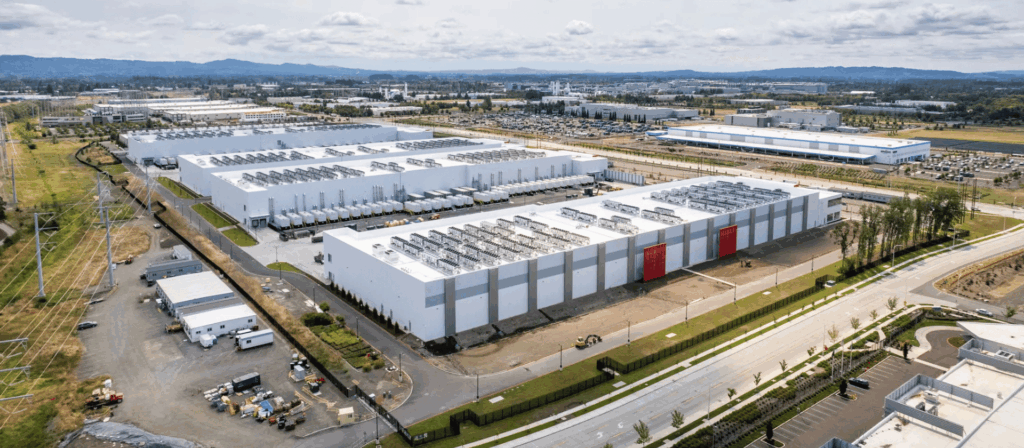
Oregon is one of the nation’s top destinations for data centers, attracted by the state’s cheap power and favorable climate. Despite the state being an ideal location for data centers, Oregon and communities like Hillsboro in Washington County have been doling out massive tax subsidies to the corporate owners of data centers. That has been a very foolish thing to do, says Dirk Knudsen, a real estate broker and editor of the Hillsboro Herald. Dirk has followed closely the rise of data centers in Hillsboro. In this episode of Policy for the People, Dirk shares what he’s learned about the data center boom.
Listen to prior episodes of the show
Follow Policy for the People on your favorite podcast app



Transcript
[We make this transcript available for your convenience and to increase the accessibility of our content. The transcript was generated by software and was slightly edited for clarity. If you are able to, we encourage you to listen to the recording.]
Juan Carlos Ordonez (host): After years of subsidizing the development of data centers, some states have begun moving in the opposite direction. Rising energy costs due to the massive electricity consumption of data centers. Environmental impacts. The cost to state and local budgets from data center tax subsidies. The paltry number of workers the data centers employ. All of these factors are prompting lawmakers in states like Virginia, Georgia and Arizona to consider legislation to repeal or limit tax breaks for data centers, according to a recent report in Stateline.
But what’s happening here in Oregon, one of the premier destinations for data centers? Just in terms of property tax breaks, this year, Oregonians are subsidizing data centers to the tune of about $450 million, according to The Oregonian. So far, Oregon has seen little in the way of action in terms of putting an end to subsidies for data centers. In the just concluded 2026 Oregon legislative session, a bill introduced by the governor would have opened the door to even bigger tax breaks for data centers by lengthening the duration of the tax break known as Standard Enterprise Zones, one of three tax breaks in Oregon that data centers have feasted on.
At the last minute, however, the bill was amended to actually put a one-year moratorium on the ability of data centers to get new or expanded tech subsidies from the Standard Enterprise Zones tax break. But the tax breaks data centers have already received under the program remain in place, and the bill puts no moratorium on the ability of data centers to claim other tax breaks.
In this episode of Policy for the People, we examine the impact that data centers are having here in Oregon and one community in particular. Hillsboro in Washington County is one of the main sites for data centers. To discuss what’s been happening in Hillsboro, I spoke with Dirk Knutsen. Dirk is a real estate broker and editor of the Hillsboro Herald, a local news source. Over the last several years, Dirk has been tracking closely the impacts the data centers are having. His conclusion is that we as Oregonians have been very foolish in how we dealt with data centers, subsidizing them heavily despite the many harms they bring and the meager benefits they produce. I began by asking Dirk what sparked his interest in data centers in the first place.
Dirk Knudsen: Yeah. So on the real estate side, I have done hundreds of land transactions in Washington County. And part of what happens when you do land, is you get to know the ecosystem of the players. And, you know, who are the big developers? Who are the big movers? When you see large land transactions and some of them I got to participate in, you also pick up a lot of firsthand knowledge about what are the motivations to, you know, to buy land.
What are the motivations for different players? So I work with different companies. About half my business is commercial, which in Hillsboro has meant expansion, which we’ve been in for decades here. You know, Hillsboro is kind of the jobs town of Oregon in the modern era, with the arrival of our tech firms from the 1980s forward.
And I’ve been doing real estate since I was 18. My father was a broker. And so, all around the Orenco station where I grew up, those were my childhood fields that I got to play in. And I got to, you know, explore and find native artifacts and just get totally immersed in that early, earlier time in Washington County’s history.
My father was a well-known broker. I had a call to community action over a number of things, including a large state prison that was going in Hillsboro. And that was my first entree into community service work. You know, beyond working in the school district with coaching sports and being involved with PTA and things like that.
And so some of these land transactions early on for the larger industrial players included. Looking at what was going on with Intel, on their acres and looking at the strategic investment program and then asking bigger questions, what’s this doing to my town? You know, what is that steam coming out of that big plant? And why don’t they pay any taxes?
And how do we monetize that? How is my community going to benefit? And then over time, it went away from semiconductors and tech. And about 20 years ago, I was able to see the very first fiber optic cable that came into Washington County, and got a chance to see, what they call a NOC Center, which is a network operating center of the very first fiber cable, maybe not 20 years, but it was 15 years ago.
And here, Microsoft execs that were running that, at Tennis Form Parkway, there was a building and then there’s this cable, and then there’s six men in a room with 20ft monitors, monitoring internet traffic up and down I-5 and then getting my head around what that was and understanding how important it was. At that time, all of us had dial-up, and early DSL, right.
And that I got a chance to see that. And then I saw the real estate around that. And, that was a very early entree into what was really more of a network operating center with a small data center. And then I kind of put that on the shelf, and that not a lot happened after that until about 7 or 8 years ago.
A couple of very large pieces of land were bought. And, I was out there in the parking lot of what is now Digital Realty, which is just north of 26, as you make your way into Helvetia, which is our countryside here and massive building, ten acres under roof was going up, something we hadn’t seen since Intel.
And then hearing the site manager, who knew me through more of a real estate connection, you know, sort of talking to me and sort of bragging about the monetary aspects of what was going to happen in that building. And he told me, when this building’s full of computers, you’ll be able to wear a ten gallon Texas hat and walk into the middle of that facility, take your hat off, hold it upside down and fill it with gold coins.
Dump them out and continue to fill it 24 hours a day. And so that spiked my interest. And since that early time, I have seen, the land that came in to the urban growth boundary and what is now, famously known as the Grand Bargain, which was the first big land use expansion that went outside, the land use systems that Tom McCall had set up for us in the 70s as part of, you know, his dedication to Oregon’s land, that we had a process and we would go through this process.
And so we had this period of 1,100 acres of industrial land just west of Brookwood, out here near Topgolf is kind of a landmark people can identify. And then slowly, hearing that land parcels were being taken off, you know, taken down. And there were private negotiations and NDAs. And just as a broker starting to ask questions, I’ve always been inquisitive.
I’ve always wanted to source what’s happening. Which eventually led to my journalism work out here. And, we began to see, oh, there’s going to be this thing called the data center out here. And so about five years ago, one of our larger players, QTS, came to Hillsboro and built five in a row, very massive facilities that started a construction boom of epic proportions with thousands of people coming in from out of state to build these things and in-state as well.
And it’s been great for the labor union, unions and electricians. But as soon as they get done, they leave, and then you start seeing empty parking lots and you realize, you know, that 30 people work in buildings that total millions of square feet, that normally we would have hoped would have employed thousands of Oregonians. And and so the data center side to what I began to do was about 5 or 6 years ago.
And then I got interested in the chess game of who’s going to take down the next parcel.
Juan Carlos: So those roughly 30 data centers that you mentioned, have those all kind of sprung up in the past few years?
Dirk: Yeah. The early ones would have been maybe six and a half years ago. And right now we’re actually trying to say, why doesn’t anybody have the definitive list of who’s here?
I ended up having to put together a Google map, which has been shared pretty broadly, especially with politicians in the legislature lately. It’s an interactive Google map, and it lets you kind of fly in on Hillsboro and click on dots where I’ve added information. And so the city right now is saying we have 18 officially.
I count 29 and I know there’s another 4 or 5 coming. And so it has been an absolute explosion of this category, leading into what’s now the AI boom, which is all directly tied to our data centers.
Juan Carlos: What do you think is bringing all these data centers to the area, like, what are the advantages that Hillsboro offers to these corporations that own the data centers.
Dirk: At first, the messaging in Oregon, in the data center community, and it continues today, is that there is no better place in the country to bring a data center other than Oregon. Roanoke, Virginia is known broadly as being the capital of such places. They have upwards of 200, but that’s also a massive suburban area of millions of people, next to Washington, DC in that area.
So it has implications. But for me, all you have to do is go to one of the data center’s website. So if you go to Stack, which is a big data center, they’re all owned by private equity firms, which is also a revelation we’ve had to learn. They tell you why they’re here in their messaging.
They’re advertising for companies to come and take rackspace down in these buildings. And so they’ll say things like abundant power, like can’t get better power or more affordable power in the country. They get massive tax credits for using renewable energy. So they sign up for all of that, and they use up a lot of our energy tax credits and our renewable purchases that can be done.
So that’s number one is power. Number two is the climate’s very friendly. Data centers create a massive heat. And if you put them in Arizona, which there’s lots of them or Florida or wherever they else, they could put them, or Texas, it’s very hot. So the cooling aspect is a bigger issue. And then there’s things like public policy.
And number one for them now is that we don’t have a sales tax. So Oregon has no way to monetize these. And they know that, even if we had a sales tax, it would be very difficult because they don’t report their economics very well. And so there’s really a checklist of cheap power, relatively cheap land, amazing climate.
And then sort of unbundling that, to another thing that just has been talked about recently is that for whatever reason, Oregon and particularly Washington County ended up being the pathway for eight submarine, Trans-Pacific cables that connect all of the Pacific Rim, including, now we’re finding out and have confirmed that all of the internet traffic to mainland China, to the People’s Republic of China now runs through Hillsboro.
The real story in Hillsboro is those cables. And, they’ve now, the different companies involved have now all been talking internally that, hey, we’ve created a fiber ring. And I had to learn what that was. And so a fiber ring is basically where you have a location where multiple cables are in 1 or 2 buildings, and then it’s not like one company selling its service.
It’s multiple companies now have fused their cables together, almost like, your veins or your nervous system in your body. If one goes down, the others pick up and take over. And so, what they call redundancy, the ability to never go off line or to be assured you’ll never go offline. So if you’re a company, doing business in the United States and you’re communicating to the hundreds of millions of people or billions of people between China and India and, you know, South Korea, Australia, New Zealand, Japan, all of those countries, massive markets.
You need that redundancy. It’s being widely reported now that Hillsboro may be one of the three most critical locations in the world for this type of location.
Juan Carlos: Have you ever had a chance to tour one of the data centers? And what are they like?
Dirk: I have. It’s like walking into a massive, indoor NFL or NBA or NFL football arena.
Some of them actually have enough space to put multiple football fields inside the building, and then they’re upwards of 70ft high and you would think, oh, they’re just going to have some computers on the ground. But these racks actually rise up. So you’re almost walking through what would feel like the Library of Congress or the Smithsonian or something. Where you’re in these narrow, they’re not narrow, but these lanes of of where you can travel through and then just massive banks of computers from the floor all the way to the ceiling and, the noise and the lights and just everything going on, the heat, the energy, the magnetic pulse going through, it’s something to behold. And it’s something that anybody working in this space would aspire or want to be able to do.
Juan Carlos: How do you think the arrival of data centers in Hillsboro in such numbers have impacted the lives of the people of the community and the surrounding area?
Dirk: Yeah, so that’s a good question.
Has it helped? Well, there’s all kinds of messaging around, “Well, we need high speed, you know, data that’s good for us.” Well, one of those buildings is enough to supply all of us in Portland. It’s not uncommon for, like,100 megawatt facility could power maybe 700,000 homes with high speed internet. We had good internet before.
Now we have amazing capabilities. I watched people get very wealthy. Some of the landowners were able to sell at prices we never would have dreamed of. Early on, it was $250,000 an acre where farmland was being converted. That I saw it go to $500,000. The city of Hillsboro itself has purchased a lot of land in that Grand Bargain area, and they’re playing developer with it, holding it, and they’ve paid up to $1.3 million an acre now.
And I’m being told by pretty good sources that we haven’t even seen the tip of the iceberg in terms of what companies are going to be willing to pay for what we have left, what land we have left. And so there’s the wealth that’s been created through the land ownership. What those people did with their wealth was go buy more real estate or leave the state or whatever they did.
Right. The construction jobs no doubt created wealth for a lot of people and a lot of companies. But when you see it on the street and you think about it, I’ve talked to so many people from Hillsboro that didn’t realize what was going on, that don’t drive out there into the industrial parks north of town. And when they do come out here, they’ll say to me, hey, what the hell happened?
And I’m like, well, this has been going on. It’s just I think they all thought it was more packaging facilities or more tech, and that somehow all these jobs would come. So I think that’s part of it. Directly economic benefit, I think it’s kind of there, but it’s kind of not. We’re learning, you know, kind of how companies like Core Weave have gotten or TikTok is here.
And so they’ve calculated how much taxes did we give them, how many free property tax dollars did they get. And it equated with TikTok. The community’s paying $520,000 a year per employee to have them here. That’s what we pay to have TikTok here.
Juan Carlos: We are subsidizing each job by that amount.
Dirk: Yeah. And so, on the other hand, I see our schools struggling, Washington County itself, who would have been a huge recipient of those property tax dollars, is effectively bankrupt.
I mean, they’ve said that and it should be the richest county in the state, given the industrial base we have here. Most cities do not have a big industrial base. The goal is that when they roll off the enterprise zone, that these will be and ( I’ve had this told to me by the very top people in Hillsboro leadership and management) is that these are ATMs, and we’re just waiting for them to start kicking the cash out.
I’ve heard messaging, controversial as it is, that people don’t matter, as much. You don’t need to attract more people to a city like Hillsboro. What you want is industrial revenues so that you can enrich the city and Hillsboro has amazing parks.
And, you know, what we’re doing with the baseball stadium. And, I think you’ll continue to see Hillsboro do some pretty incredible things with this huge tranche of money that we have. So those benefits long term with property tax revenues will be great. From a jobs perspective, it hasn’t been great. And I think the other thing is we’re losing our sense of place.
We were a very big agrarian town. That was Hillsboro. That’s Hillsboro was one of the earliest cities ever to develop in the state of Oregon. It’s whether people realize it or not. The first early farms and the first few homes that were built in western Oregon were built in the Tualitin plains, in Hillsboro, what’s now Hillsboro, not in Portland.
So our early housing predates really any housing in Portland. And so people think of us as a suburb. But early on in that pioneer era, it was really an important place of trade. And even when I was young, it was agriculture, not industry. And now we see agriculture has been pinned down.
And so, as you drive into Hillsboro, now on many of the streets, you can’t see the mountains anymore. A lot of us that have been here very long feel like we’ve lost what we had. We feel like the bucolic aspects of it are gone. The other thing Metro reported on was we’ve got this massive heat island out here now, and this heat island that exists in that part of Hillsboro, warms the climate about two degrees warmer than other areas in Portland as these giant concrete facilities put off heat all day long.
So. And we don’t really understand the environmental impact because really, we haven’t done any work here to understand it. So those are some of the pluses and minuses.
Juan Carlos: I want to go back to something you said and to see if I understood correctly. You said that in the long term, the property tax revenue will be good for the area.
Currently they are not paying, paying nothing or very little, perhaps.
Dirk: Very little. Yeah. So, part of what I’ve done is I’ve tried, through the city, the county and other organizations, as I’ve tried to say, hey, give me the list. I want to see how much the tax breaks are. And there’s really good people like Jody Wiser, Tax Fairness Oregon in her group, who have also asked.
The city provided Mike Rogoway, the county provided Mike Rogoway from the Oregonian a list of who is getting enterprise zone treatments. And I think Mike reported it was like, it’s like $50 or $60 million a year. We’re going without my own internal audit. Just looking at tax statements and taking, you take the assessed value and you take what we call the millage rate, which is the amount we all pay per thousand for our real estate.
You know, in Hillsboro, it’s $16, very cheap, where Portland might be $25 or so. That breaks down to 1.6% value per year is what you pay. And so just looking QTS, for instance, every year they’re reaping about a $30 million benefit. And when you take a tax statement and you look at hey, where’s that money go?
It’s split up between the city of Hillsboro General Fund, the county’s general fund, Hillsboro School District has lost upwards of $140 million. And, just the last few years, that they don’t get.
And so, you know, as you look at those numbers, the hope is that as these enterprise zones end, we will see new revenues that we were hoping we would get.
Right. And so leaders at the very top level say, don’t worry, the money’s coming if we just have to wait for it. The question is, did we have to offer that gift to them to get them here? And I think there’s a lot of messaging that what we did or they wouldn’t have come here.
I think all of us that are learning more about this, especially with these cables, are now learning, we didn’t need to do that at all. They were coming here either way. And we’ve been very foolish. And this will be a discussion that the state will have is and it’s happening right now. So for Hillsboro, the argument is if we didn’t give them the tax credit, they wouldn’t have come and then we wouldn’t have these future revenues.
Right? The carrot was put out, they bid on it. They bit the bait. They’re here. I don’t think we had to do that. I think without jobs, I don’t think that was a strong enough argument to bring in here.
Juan Carlos: Speaking of jobs, how many people do these data centers employ? Not a lot. Is that correct?
Dirk: We just put up a very recent drone tour on our Instagram account at Hillsboro Herald, and I fly over about 15 of them, and it’s interesting. And I have some still frames I’ll be publishing to look at a parking lot with 300 spaces and see ten cars. Right. And so the state doesn’t require nor does the city, that there’s any minimum floor on how many jobs they’d have to get in order to provide that. The construction jobs, there’s hundreds or even thousands at times.
But that’s this wave of income that comes and goes. And when it’s gone, it sort of gets down to that per square foot. You could get into a per acre number and it would be so meager that a farm could technically, the farms that were there could have employed an equal number of people.
Juan Carlos: I wonder if you’ve ever met someone who works at the data center, apart from the from people who helped build it, but someone who works there permanently?
Have you met anyone who works there, and what do they tell you about?
Dirk: Well, they comment. Some of them will comment on our social media posts [at the Hillsboro Herald], said I have this job, but I don’t love it. And I can’t make more than about $35 to $50,000 a year. A lot of them are working security. Some of them work building maintenance, some of them do work.
So, for what we call co-location facilities, which is very common in Hillsboro, a development team will build a massive building. So say that Blackrock, who I consider to be sort of the evil empire. They built several and then they basically lease out space. I think of it very much like a hotel. And so they’ll lease to TikTok.
So TikTok then brings in, say, 5 or 6 employees or maybe three employees to be on site. And they’ll provide amenities in these buildings. So they’ll have like, you know, offices and community space. And some of the new data centers are going to probably have living quarters. That’s the new trend. They’re going to have little mini gyms.
It’s going to be like, it’d be like if you went to Washington Square and a handful of employees work there, and that’s inside that whole mall. We had enough people where you’re like, let’s, let’s give some benefits. So they’re starting to offer office suites and other benefits to attract people who will pay millions of dollars for some banks of computers.
Juan Carlos: So as we’re speaking, the 2026 Oregon legislative session is coming to an end. And at the start of this session, there was legislation introduced by the governor that would have lengthened the amount of time that data centers could claim the enterprise zones tax break that you referred to earlier. As we are coming to the end of this session, though, things have turned around a bit.
It looks like, in fact, data centers will be excluded from that expansion. In fact, there’ll be, the proposal is to put a one year moratorium on the ability of data centers to claim that tax break going forward, those that have the tax break will continue to receive it. But at least for one year, there will be a pause on new tax breaks for data centers, for this one tax break. There are other tax breaks that data centers receive.
But I’m wondering what your perspective is on what’s transpired during the legislative session, and also what you would like to see the legislature do perhaps next year when it meets for a longer period of time.
Dirk: Yeah, it’s a great question. So that’s the governor’s bill, 4084. And, this group that has coalesced around what she wants to do, there’s a lot of concern that she doesn’t have the information she needs to have.
So she convened her panel of six, and I testified at their first meeting last week in Portland. And the first meeting was pretty much all eastern Oregon and hearing all the accolades from these eastern Oregon towns. So the mayor of Prineville was there. Prineville reaps some huge benefits. But what they’re looking for and what they need, is different, like I said, than the West side.
So 4084 was going to allow that to be a ten year enterprise zone, which I think it’s just a gross error that anybody thinks, that we need to do that. It doesn’t matter if they have these cables we mentioned or not. Oregon is a power-rich state, but we’re giving it away so cheaply. Again, don’t need to do it.
They’re coming either way. And I can guarantee you that just from my real estate side, from what I’m hearing, there’s no better place for them to come. It doesn’t matter if it’s Hillsboro or somewhere else. So what she did, and part of the reason was people like me were taking shots at her, that you’re opening the door politically, your career.
I mean, the handwriting’s on the wall. The public is angry about this. They don’t want this.
Juan Carlos: Is there anything, regarding data centers that we have not touched on yet that you would like to bring up?
Dirk: We seem to be acting very, very foolish. You’re talking about companies that are making trillions of dollars, and they’re laughing in our face about how much money they’re making here.
They’re not hiding this. They’re very, very obvious about it. For me, my energies are going to turn towards can’t stop it, maybe can pull back on the enterprise zone, but if we have to lean into it as a way for our people to prosper, then I want to see it monetized. I want to see those tens of millions of dollars, or hundreds of millions flow into the state.
And I’d like to see those monies targeted to things like education, offsetting power rates for people who are being cut off. And we’re hearing thousands of stories of people having no power now because of things like that. Or our water. Your water is a big issue, right? Oregonians, no matter what party you are in, you have to ask yourselves, what do I get out of this?
How does my household benefit, right? And then you take it up to the state level, and I hope some really great thinkers in the state level will start seeing that and realizing we have to be bold enough to say thank you for coming, but you’re not contributing to our society here, and it’s time that you do that.
And so for me, that’s where my energy is going to be spent.
Juan Carlos: That was Dirk Knudsen, discussing the impact the data centers are having on Hillsboro, the surrounding area and Oregon. Thanks for listening and we will see you next time.