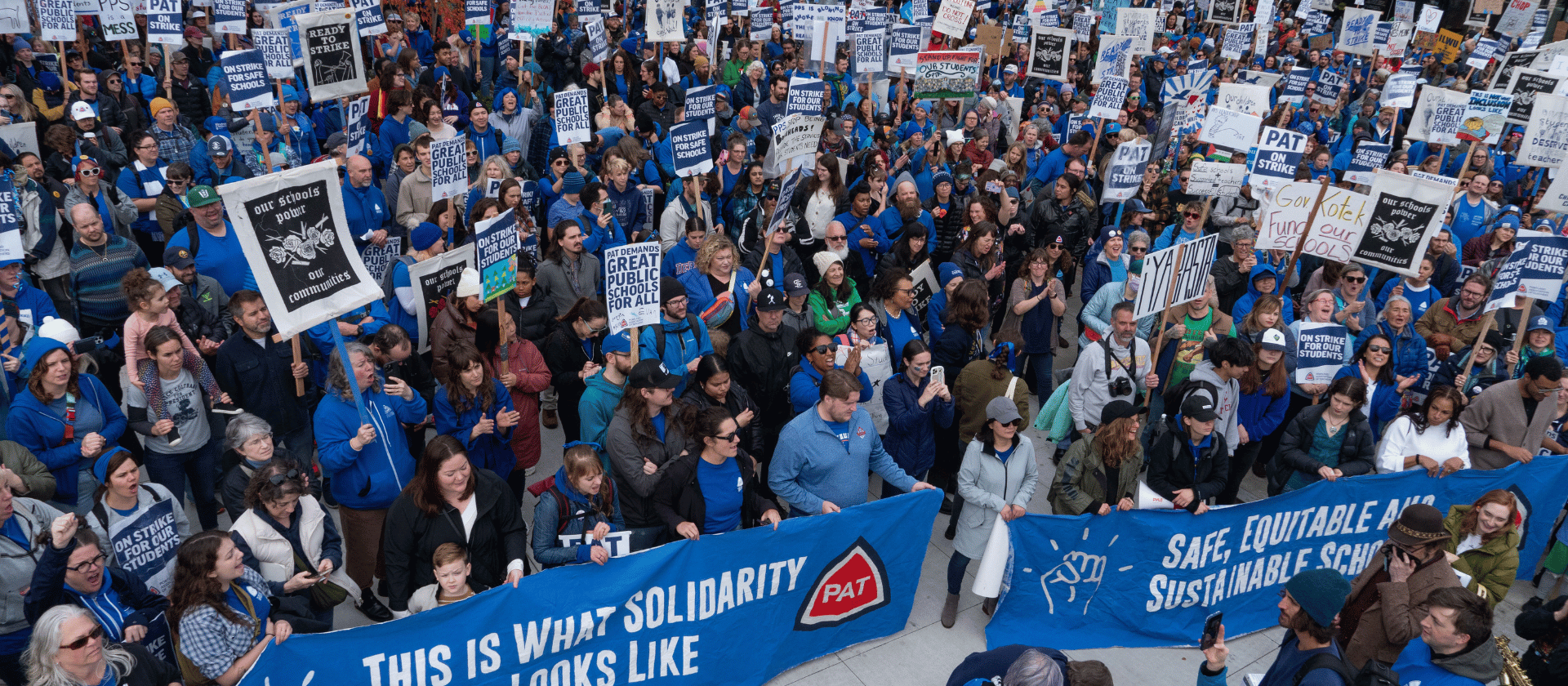
A big increase in union membership would go a long way in fixing what’s wrong with the economy, according to Jennifer Sherer. In the latest episode of Policy for the People, we talk with Jennifer about the recent report she and her colleagues at the Economic Policy Institute wrote titled “The Case for Tripling Union Membership.”
Listen to prior episodes of the show
Follow Policy for the People on your favorite podcast app



Transcript
[We make this transcript available for your convenience and to increase the accessibility of our content. The transcript was generated by software and was slightly edited for clarity. If you are able to, we encourage you to listen to the recording.]
Juan Carlos Ordóñez (host) If you had to pick one policy to dramatically improve the economic well-being of the people of this country, what would it be?
Among the top contenders for sure would have to be to greatly increase the share of workers belonging to unions. A new report out by the Economic Policy Institute, a nonprofit, nonpartisan think tank, makes the case for tripling union membership. In this episode of policy for This people, I speak with one of the authors of that report, Jennifer Sherer.
Jennifer is the deputy director of EPI’s Economic Analysis and Research Network. As Jennifer explains, a big expansion of unions would dramatically boost wages, not just for union members, but for all workers. It would also sharply reduce economic inequality, strengthen democracy and more. Here’s my conversation with Jennifer Sherer.
Juan Carlos: Hi, Jennifer. Welcome to Policy for the People.
Jennifer Sherer: Thanks for having me. Great to be here.
Juan Carlos: So, Jennifer, you and your colleagues at the Policy Institute recently wrote a paper titled “The Case for Tripling Union Membership.” What would you say is the main takeaway of this report?
Jennifer: The central argument of this paper, and the motivation for publishing it, is to help people understand and actively make the case for rebuilding union power, which we show in the paper, would significantly strengthen workers, improve some of the biggest problems in our economy, and strengthen our democracy.
Juan Carlos: So you write in the paper that tripling union density is what workers want. What do the surveys and other information show regarding people’s attitudes towards unions right now?
Jennifer: So we track the data on union membership from year to year pretty closely. And interestingly, last year, the most recent data we have, around 15 million workers belong to a union. That’s about 10% of all wage and salary workers in the country. So that actually is a slight uptick from the year before. And it means there are more union members total in the US than there have been for 16 years. So it is a tiny increase, but it’s an increase following many, many decades of a different trend, a decline in the number of workers who have access to a union contract and what we’ve ended up with in our economy.
Survey data and research is showing over and over again that there is a huge gap between the number of workers who wish they had union coverage, could have the opportunity to form and join a union, and those who actually do. So some of what the most recent data shows is that if all the workers who wanted a union actually had one union membership in our country would not be at the fairly historically low point of 10% that it is right now, it would actually be close to 50%, 48.7%.
Juan Carlos: So more than tripling.
Jennifer: Yeah, more than the tripling that we’re even proposing when we extrapolate from survey data. What those estimates produce is that over 50 million workers are routinely answering those kinds of survey questions with a yes. So if they’re asked, if you had the opportunity to vote for a union in your workplace, would you want one?
And you know, I think the public opinion polling is showing those same kinds of trends as well, that public approval ratings for unions are at historic highs of around, hovering around 70% often. And that particularly the younger you go on the age demographic scale, the more interested and enthusiastic about unions workers are. So young workers in particular are very interested in unionizing today.
Juan Carlos: Back in the 1950s, about a third or so of all workers belonged to a union. And as you said, right now, that has fallen to about 10%, despite the slight uptick that we saw recently. What explains this long term decline in the share of workers belonging to unions? What have been the main drivers of this decline?
Jennifer: Well, we have had several decades of policy choices that have suppressed wages and workers power. So, you know, those include failures to reform our labor law, which has really been weakened since it was first enacted in the 1930s in ways that have, over time, made it increasingly more difficult for workers to exercise their rights to unionize, along with many other policy choices in the economy that have eroded the floor for people’s wages. So, you know, almost 20 years of Congress not increasing the minimum wage would be just one sort of obvious, familiar example that I think a lot of people know about.
But we could make a long list of policy choices that have weakened workers bargaining power and transferred wealth to the top 1%, the top 10%, while suppressing wage growth for the vast majority of workers in the economy. So we’ve ended up with really extreme inequality, which is an outcome associated with decreasing union density. One of the things we focus on in the report, particularly, is the need to reform our labor law.
But of course, that’s one among a package of policy choices that have led to this outcome.
Juan Carlos: I wonder if you can say more about how the decline in the unionization rate over all these decades, how that has played out and is playing out today, how it’s affecting workers everyday lives and the well-being of our communities.
Jennifer: You know, we know historically and today that unions promote economic equality. They enable workers to use their own collective bargaining power to win increases in pay, better benefits, better conditions in their own workplaces. But it is also the case that unions function to raise the wages of all workers. So even those who aren’t directly covered or aren’t directly engaged in organizing effort. So the overall erosion of collective bargaining and unionization rates has taken a really big toll for everybody across the country. I talked a little bit about the inequality and the, you know, the big gap that we have between the top 1 to 10% and everybody else in our economy today. This is all, of course, directly linked to the affordability challenges that are getting lots of attention in our current politics and that workers are facing in today’s economy.
You know, we have 50 years of wage suppression leading up to the gap between people’s incomes and the prices that people have to pay for things that are necessary to survive. So, you know, affordability is always a race between prices and wages. And we hear a lot of I think we sometimes in media coverage hear a lot about how much does gas cost or other consumer goods.
But the other side of that equation is just as important and the ways in which wages have been suppressed and lagged behind over and over again for years. Inflation is really an aggregate that has led to many of the challenges people are facing today.
Juan Carlos: So you and your colleagues at E.P. make the case for tripling union membership, and you go through a whole range of benefits that this would bring to the vast majority of people in this country. And so I want to start drilling into some of these benefits, and I want to start with wages. What would tripling union membership mean for wages?
Jennifer: Yeah. So our economists estimate that tripling union density would deliver, on average, about a 14.5% raise for the average worker. So that’s the equivalent of about $7,700 annually. And if you compound that over a 35 year career, that’s $270,000 to give, you know, a sense of what kind of impact that can make on a household or a family’s income.
So and again, that’s an average estimate, not just for workers, the larger number of workers who would be covered by a union contract, but across the whole economy. So union or nonunion workers alike, just looking at the median impact. You know, I think one of the really eye opening numbers that are economists analysis generated is that if you think about our economy as a whole and the kind of stark, sharp inequality that has been embedded in it, what we’re talking about in terms of those wages over time is a shift of $1.2 trillion a year to workers.
So this would, they estimate, reverse a third of the increase in inequality that has widened that gap since 1979.
Juan Carlos: So that would really put a significant dent into the rise of income inequality that we have seen. And there’s definitely a connection between economic inequality and political power in the country. And so it seems to be like a really key kind of reform that we can make.
Jennifer: The report goes through some of the other related impacts, because all these economic questions are related to things like racial disparities that are still embedded in our labor market. Tripling union density would significantly narrow the racial wage gap, because unions tend to boost wages for everyone, but especially for black and brown workers, who are also just already disadvantaged in the labor market.
So it could close that racial wage gap by more than a third. It would boost the number of people overall with health insurance, an estimated 25% fewer uninsured Americans, if we had much higher union density. And then there are all kinds of effects on democracy measurable by things like voter turnout and how likely it is that we have voter restriction laws in place.
So the report goes state by state and does some comparisons of states with the high, middle or low union density, and finds repeatedly that higher density is far more correlated with higher voter participation rates and a lower likelihood of a state having enacted measures to restrict voting rights in various ways.
Juan Carlos: One of the things that I found interesting in reading the report is that you write that these estimates, especially when it comes to wages and the wage increases, that would follow a tripling of union membership, that this is actually a conservative estimate. And I wonder if you can explain why that is.
Jennifer: Because union density in the US, if we start from our contemporary moment, we’re really looking at a starting point of a low level of union density and trying to predict what increasing it would look like. There’s a whole economics literature that indicates that the wage gains and the spillover effects that we’ve been talking about a little bit are much larger when density is at a higher level.
And so below 15% union density, which is where our country is right now, and where a lot of states in our country are right now. A 1% point increase in density is associated with some tiny increases in the median wage when you cross that 15% threshold. It turns out that each percent you increase density by actually has a much bigger impact of increasing wages by closer to 1%.
So almost a 1 to 1 correlation there. So you need a critical mass of union members at unionized firms in a labor market to begin to get larger spillover effects. And so once crossing that 15% threshold and getting closer to 25 or 30%, the wage impacts and impacts on benefits and some of the other measures that are in the report would likely be even a lot more significant.
And of course, some states already have higher union density than others in our country. And so one way to think about this is that starting at those higher rates of union density might allow some states to, and some regions and some occupations to begin seeing, some of those impacts and benefits sooner than others.
Juan Carlos: And speaking of the differences among states, I wonder if you can describe what those differences are, and especially where Oregon sits within the spectrum of unionization rates. And also what’s behind those differences, because they can be quite significant.
Jennifer: Yeah, we have wide variations in union density in our country right now. And those differences you probably won’t be surprised to hear are rooted in policy choices also, and long histories often. So Oregon is a state with above average union density 15% approximately right now.
So that’s above the 10% national average. One thing we do in the report is delve into a little bit of analyzing how much have anti-union state policies suppressed unionization in certain states and regions. And so we particularly look at things like anti-union, so-called right to work laws, which are now on the books in 27 states. And we look at the differences among states who have or have not taken action to make sure that public employees have collective bargaining rights, which has never been covered under federal law.
And so that gets left up to states. And that means we have really big variations depending on where you live. If you are a school teacher or a firefighter or work for a state agency, your collective bargaining rights may be completely different. So just looking at those two policies and how they differ across states, our economists also did an estimate of if we were to equalize those things.
So in other words, remove the anti-union barriers that are in place in about 27 states in the country. Just those two changes alone would likely increase union density to almost 15%, so you get a big boost from removing some of the state barriers that people in states unlike Oregon are facing right now.
Juan Carlos: For the benefit of the listeners, you can just give us a quick definition of these anti-union right to work laws and maybe a little bit about their origin, because I my understanding is that the origin is quite nefarious.
Jennifer: Yeah, sure. And I’ll let people know, too, that we’re going to have another report coming out soon that focuses specifically on anti-union right to work laws that will delve into a little bit of this. First off, you know, I think a lot of folks may know this, but the phrase right to work is very, very intentionally misleading.
So-called right to work law doesn’t actually come with any right to a job or any job protection. It’s a label that was cooked up in the 1940s, and these laws originated as part of a very significant anti worker, anti-union and racist movement in the 1940s as unions were gaining strength. So after the passage of 1930s New Deal legislation, including the National Labor Relations Act, that provided a more solid floor for workers rights and for the first time, a legally protected right for workers to organize.
Unions took off in many parts of the country and in many industries, including in some contexts where black, white, and brown workers were organizing together. And particularly in the post World War Two moment, a combination of big business anti-union efforts to slow the growth of unions and of effort led by some very, very extremist, anti-Semitic and anti-Black racist organizations, in many cases teamed up to try to use state legislation to undermine the rights that workers had begun to gain.
So these laws were promoted, among other attempted restrictions, on unions in many southern states and many Western states. Some of these attempts to pass anti-union legislation at the state level were often blocked by courts because they weren’t compatible with federal law. And then in 1947, Congress significantly amended the federal labor law. So this is kind of a long historical story, and one of the ways in which the federal law was weakened in those 1947 amendments, known as the Taft-Hartley act, was sanctioning that states could maintain these so-called right to work laws.
So what a right to work law does is to weaken unions. That’s its intent. It prohibits unions and employers from bargaining over the terms under which everybody covered by a particular union contract will become part of the union and will pay some sort of fee toward their representation costs of union representation. And so it’s a provision that’s intended to interfere with the bargaining process that under federal law has been set for the whole country.
And so what it means is that in right-to-work states, unions are left in a permanently precarious position where it remains unknown whether future hires will join the union or not. And it just opens up the potential for employers to continuously interfere with or attempt to bust unions on an ongoing basis. We know that’s a problem already with our labor law.
When people begin to organize, often what they face is really, really harsh employer interference, and our law is not very strong in prohibiting that, even though on paper it says employers shouldn’t interfere with people’s rights. And what a right to work law does is just add yet another layer of opportunity for employers to potentially interfere on an ongoing basis with the membership levels of a union that’s already been formed.
Juan Carlos: So let’s switch gears and talk about policy solutions, what it would take to actually triple union membership. And I want to start at the state level. And you already think alluded to two key actions that need to take place. One is for removing these anti-union right to work laws and allowing public sector workers to unionize. I don’t know if you want to say more about those policies, but what else beyond those, especially in a state like Oregon, what the state could do?
Jennifer: Yeah, and I think the state of Oregon is a really good example of a state pursuing many of the opportunities that the limited, I shall say, opportunities that states have to make some difference in reforming labor law.
We focus in the report on a couple of policies that are likely familiar to people at the federal level, that would restore some of the elements of labor law that have been removed or weakened over time, including through those big 1947 amendments that I mentioned. So we do talk in the report about the PRO Act, which has in fact passed the House of Representatives in Congress twice already. It has yet to make it through the Senate.
But it’s an act that makes a long list of changes to federal labor law, doing things like streamlining the process for union elections, which right now are often an opportunity for employers to delay and interfere, making it extremely difficult for workers to exercise their rights to form a new union. Similarly, the PRO Act would create a clear timeline and a process for making sure that newly unionized workers can reach a first contract is another part of the process where there is not a lot of teeth.
In our current law that says the losses on paper, that employers should sit down and bargain in good faith with a new union, but in practice, there are very few levers for our National Labor Relations Board to use to get them to actually do that. It would establish civil monetary penalties when employers violate the law. Again, this is about giving the law a little more teeth than it has right now.
And it would take care of some of the inequities across states that we’ve talked about. So it would reverse that 1947 amendment and stop allowing states to sustain anti-union right to work laws that undermine people’s federal collective bargaining rights. And it would eliminate some of the tactics that employers have legally been allowed to use since 1947 to block union activity, including so-called captive audience meetings, where workers are required on the clock as part of their job to listen to lots of sometimes threatening and coercive information about why they should not organize a union.
So a long list of reforms included in that federal proposed legislation. There are elements of that that some states are already attempting to adopt. So there are several states, and I believe Oregon was the first one to implement this, that have at the state level in a broad way protected workers freedom to refuse to participate in so-called captive audience meetings if they’re not related to their job.
So if an employer is attempting to force workers to listen on the clock to political, religious or anti-union information, workers don’t have to put up with that and can’t be fired or disciplined for opting out. Oregon of course does already have a very robust framework in place, covering the collective bargaining rights of public employees. There are other steps that states can take.
You know, we still have only a handful of states in our country that have taken action to ensure the collective bargaining rights of other groups of workers who are still left out of federal law, such as agricultural workers and most domestic workers. So those are perhaps the next important frontier for states to begin making sure that all workers, no matter what their occupation is, have collective bargaining rights.
Juan Carlos: Jennifer, any final thoughts you want to share with us regarding this aim to triple union membership, what it would mean for the people, this country, and sort of what the outlook is, or if you’re hopeful that there’s a good chance of moving in that direction.
Jennifer: Well, I mean, I think one thing to be hopeful about is, whether policymakers are moving in the right direction or not, workers are continuing to try to move in the right direction. And I think what we know from history is that it will take more workers organizing and creating the necessary motivation for policymakers to take bolder action. You know, I think that one thing I have noticed in people’s responses to the report is that it’s helping more people to connect the dots between the importance of unions in our economy, not just for the specific subset of workers who are covered by a particular contract, but the reality that no matter what type of issue you might care about the most, whether that is, of course, affordability, inequality, reproductive rights, immigrant worker justice, democracy and combating authoritarianism, all of those issues are necessarily linked to whether people have enough collective power in our economy. And we know that the number one best mechanism for addressing the deep imbalance of power, both in places where people sort of places but in the broader economy and political system as a whole, is having stronger, robust, independent, worker led organizations. And that’s what a union is. So the unions are not the answer, probably to everything. But having stronger unions would put us in a position nationwide to tackle a much more hopeful way. Almost all of the biggest problems plaguing our economy right now.
Juan Carlos: Well, Jennifer Scherer, thank you so much.
Jennifer: Yeah, thanks for having me.